July 29, 2026
14 Best Author Website Examples (2026) You Can Copy
Discover 14 Author Website Examples for 2026, with what to copy, what to skip, and the right next step for your genre. Get ideas to boost book sales.
TL;DR
The best author websites share common traits: they put books front and center, give visitors one obvious next step, and match the author’s genre in look and feel. This article breaks down 14 real author website examples organized by use case, from nonfiction lead magnets and romantasy fandom hubs to book club resources and direct-to-reader stores. Each example includes what to copy, what to skip, and which career stage it fits.
The Best Author Websites Are Working Websites
The best author websites do more than look good. They help a reader decide what to read first, where to buy it, how to stay in touch, and whether the author is worth trusting with their time.
That matters because most readers will not randomly discover an unknown author’s website. Practitioners on Reddit report that author websites and mailing lists function as “owned” channels, capturing attention that originates elsewhere: in the back matter of a book, a social media post, an ad, a podcast appearance, or a bookstore event. One commenter put it plainly: email is not a discovery tool, it collects readers you met elsewhere and keeps them warm between releases.
So your website is not a magic traffic machine. It is a conversion layer. The author website examples below show exactly how that conversion layer should work, whether you have one book or twenty.
Explore book marketing services to drive the right readers to your site once it is ready.
Author Website Examples at a Glance
This comparison table summarizes all 14 examples. Scroll down for the full analysis of each site.
| Author | Best For | Primary Job | What to Copy | Tradeoff |
|---|---|---|---|---|
| James Clear | Nonfiction lead magnet | Email capture and authority | Free chapter, email course, bestseller proof | Fiction authors need genre-specific magnets |
| Austin Kleon | Author blog and content hub | Reader retention through content | Frequent posts, simple nav, books near blog | Stale blog hurts trust |
| Rebecca Yarros | Romantasy fandom and launches | Preorder engine and bonus content | Series hero, free novella for signup | CTA density overwhelms smaller catalogs |
| Brandon Sanderson | Epic fantasy worldbuilding hub | Fandom operations and backlist nav | “Where do I start?”, progress bars, free fiction | Too complex for debut authors |
| Colleen Hoover | Direct-to-reader ecommerce | Signed book sales and merch | Shop integration, reading order, add-to-cart | Requires fulfillment and customer service |
| Brené Brown | Nonfiction authority ecosystem | Multi-channel credibility | Press kit, podcast hub, global retailer links | Enterprise-scale; simplify for debut nonfiction |
| Nita Prose | Book club resource site | Reader resources and word of mouth | Downloadable discussion guides and kits | Email CTA could be stronger |
| Judy Moody | Children’s series and educators | Kid/parent/teacher engagement | Activity pages, teacher resources, series nav | Series-brand site backed by publisher |
| Ali Hazelwood | Romance backlist organization | Subgenre browsing and newsletter | Categorized novels and novellas by subgenre | Cover grids need trope tags and reading guidance |
| Rupi Kaur | Poet and artist brand ecosystem | Brand world, shop, and tour | Branded newsletter, art/merch, tour dates | Shop-first can overshadow book discovery |
| Victoria Aveyard | Preorder and social proof | Launch focus and review blurbs | Single-release hero, preorder CTA, review quotes | Too many blurbs become noise |
| Angie Thomas | Multi-role author brand | Speaking, film, and educator resources | Press kit, teacher guides, speaking CTA | Multiple roles can dilute book CTA |
| Seth Ring | LitRPG series navigation | Series browsing and fan retention | Series dropdowns, branded newsletter name | Assumes readers already want to browse |
| Brit Bennett | Literary fiction social proof | Praise and book club credibility | Review quotes as design elements, book club kit | Can feel static between releases |
What Makes a Great Author Website?
Before looking at specific examples of author websites, it helps to know what separates effective from decorative. Five criteria matter most.
Clarity. Can a first-time visitor tell within five seconds who the author is, what genre they write, and what to do next?
Offer. Does the site present a clear next step? Buy the book, preorder, download a free chapter, join the newsletter, book a speaking engagement, or download a book club kit.
Voice. Does the design match the writing world? Romantasy can be lush and immersive. Literary fiction can be spare. A strong professional book cover is often the single most important visual asset on an author website, so get that right before worrying about fonts and navigation.
Evidence. Does the site prove the author is worth a reader’s time? Bestseller badges, review blurbs, press mentions, awards, and backlist depth all count.
Retention. Does the site keep the relationship going? Newsletter signup, bonus content, reading order, free fiction, events, blog, or shop. Google uses the mobile version of a site for indexing and ranking, so every author website must work on a phone.
Best Author Website Examples by Use Case
1. James Clear
Best for: Nonfiction authors building an email funnel
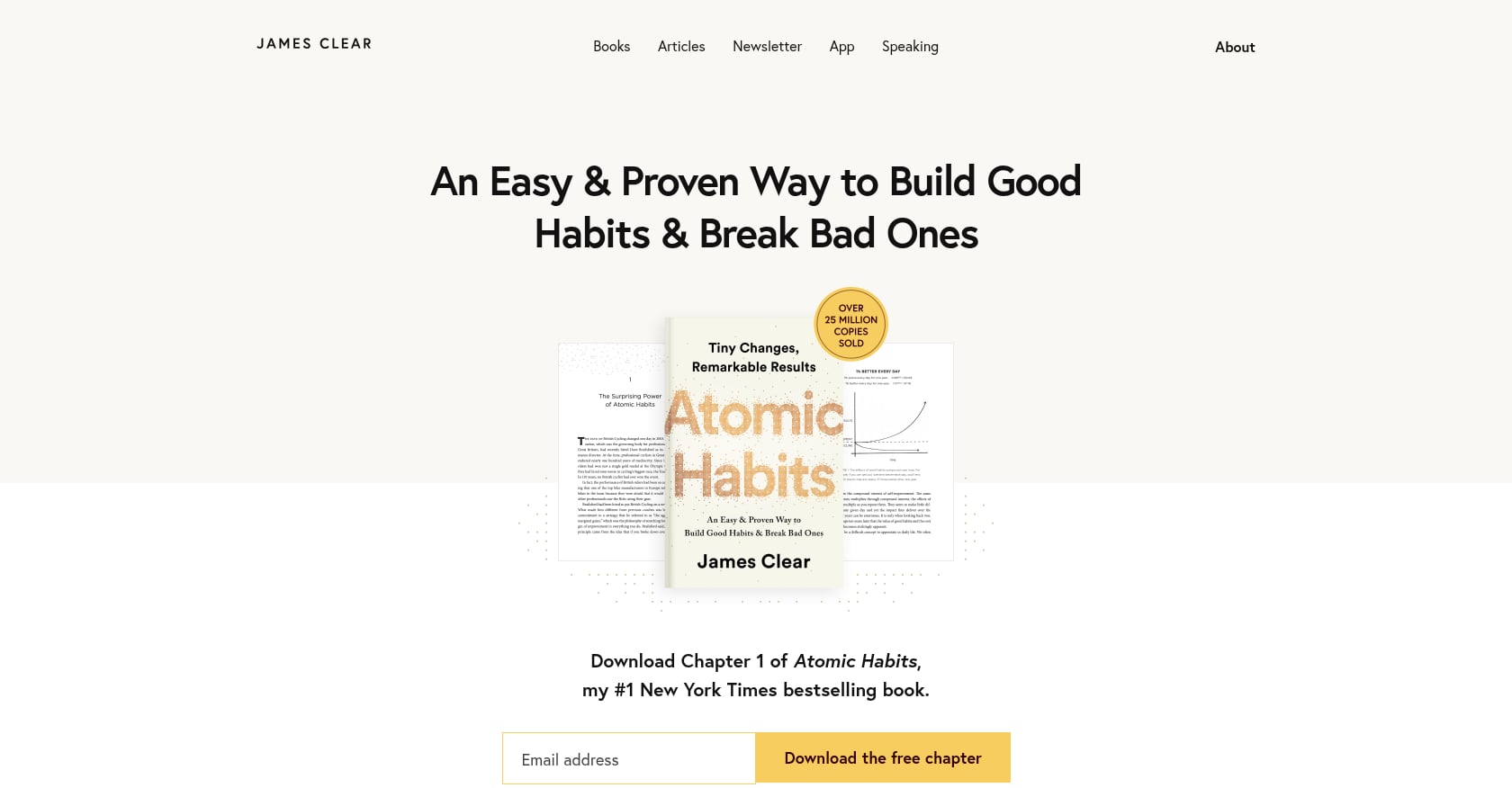
James Clear’s homepage is a conversion machine. It immediately offers Chapter 1 of Atomic Habits as a free download, establishes authority with bestseller status and sales volume, shows press credibility, includes a newsletter archive, and offers a free 30-day email course. Visit jamesclear.com to see the full setup.
What to copy:
- Tie the lead magnet directly to the book’s promise
- Make the email signup valuable, not just “join my list”
- Show credibility without burying readers in biography
- Keep the above-the-fold call to action simple and singular
Tradeoffs:
- Fiction authors should not copy a generic “download chapter one” unless the sample truly sells the hook
- A romance, mystery, or fantasy author will get better results from a bonus epilogue, prequel story, or deleted scene
- High-conversion lead magnets require ongoing email sequences to retain subscribers
Practitioner perspective: BookBub’s author email guidance notes that newsletter growth works best when readers get a clear value exchange, and many successful tactics route people to a dedicated landing page rather than a generic subscribe form.
2. Austin Kleon
Best for: Authors who blog or publish ongoing essays
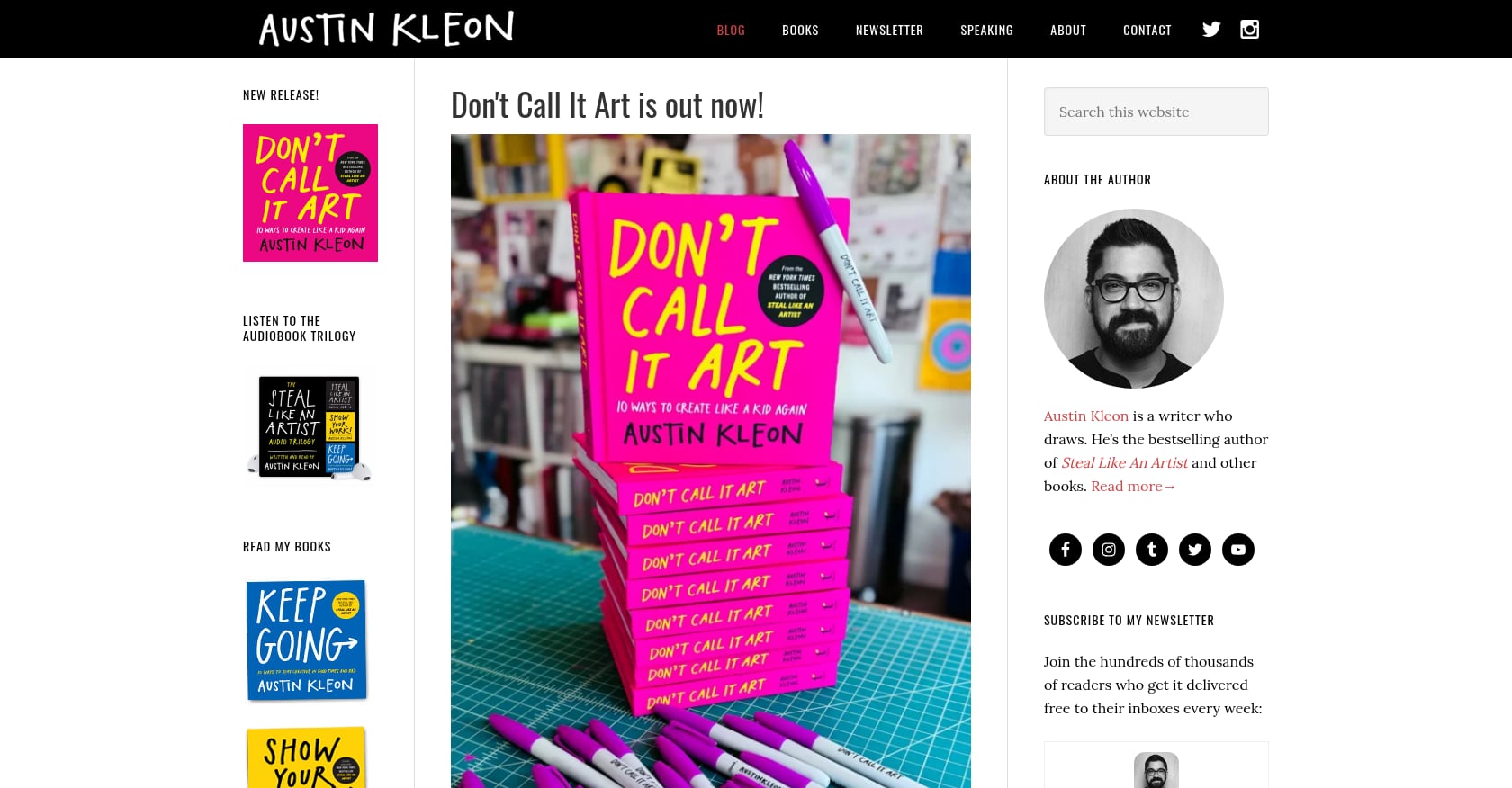
Austin Kleon’s site is active, personal, and frequently updated. The homepage shows his latest release with buy links, an author intro, recent blog posts, newsletter copy, books, and social links. Visit austinkleon.com for a model of the content-hub approach.
What to copy:
- If blogging, make the blog central and current
- Position books and newsletter close to active content
- Use a simple layout that supports frequent publishing
- Let personality show through the writing and design
Tradeoffs:
- A blog only helps if the author can sustain it; a last post from three years ago is worse than no blog at all
- Blogging competes with writing time, and Reddit authors often note that tension between marketing effort and manuscript production
- Content hub models work best for nonfiction experts and essayists, not every fiction author
3. Rebecca Yarros
Best for: Romantasy and fandom-heavy series authors
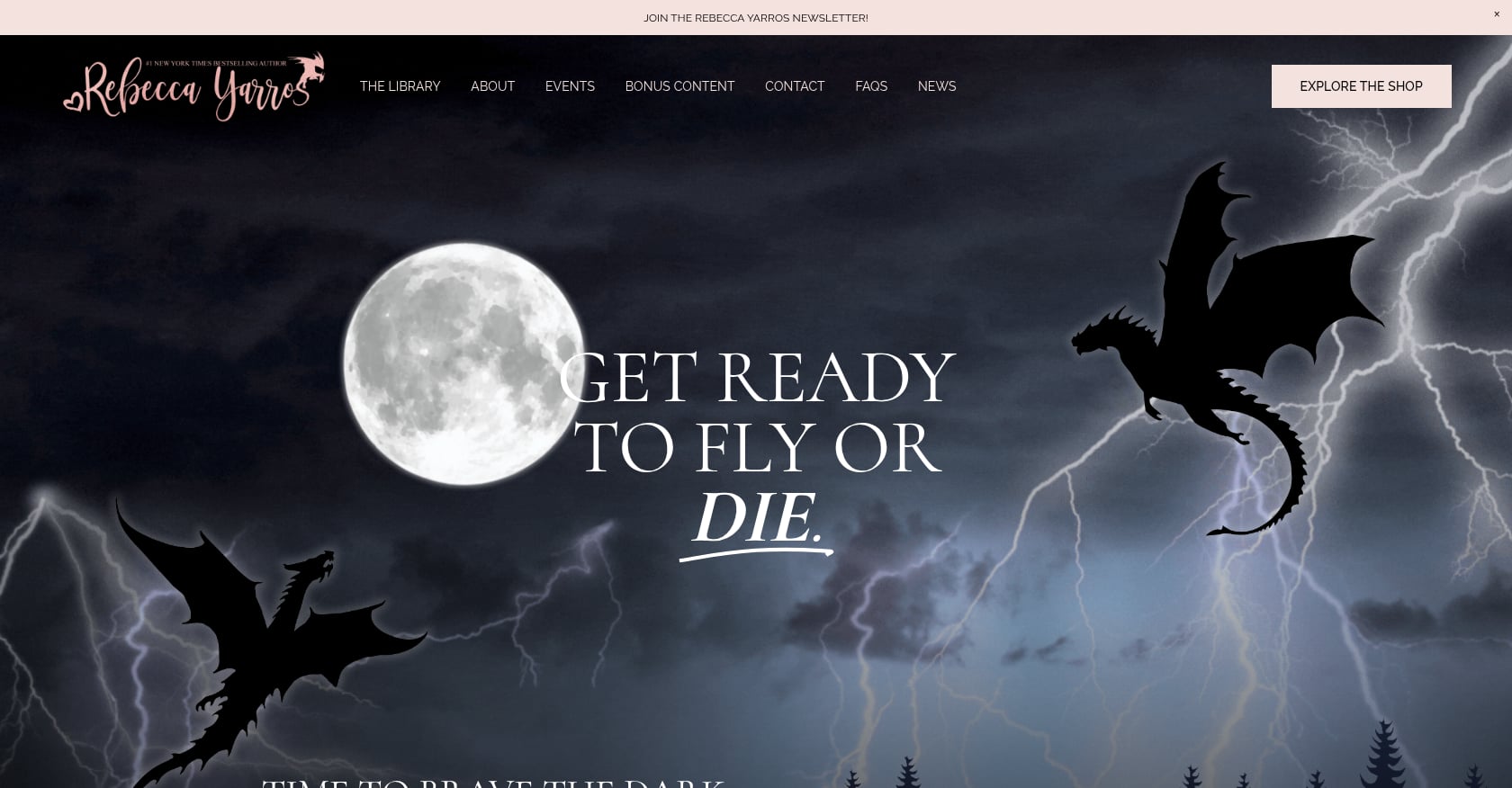
Rebecca Yarros’s site is one of the strongest author website examples for commercial fiction with a devoted fanbase. It includes a full library, events, bonus content, FAQs, news, shop, buy/preorder buttons, and a newsletter signup offering a free novella. Visit rebeccayarros.com to see how fandom and commerce meet.
What to copy:
- Use the hero section to signal genre instantly
- Give fans a clear path: buy the current book, discover the series, see events, get bonus content
- Use a free story or novella as the newsletter incentive
- Make preorder dates impossible to miss
Tradeoffs:
- This level of visual intensity and CTA density is not ideal for a debut author with one book
- The site requires constant updates around launches and events
- Copy the structure, not necessarily the scale
Authors approaching a launch should pair their website with a solid preorder and ARC timeline to get the most from that burst of attention.
4. Brandon Sanderson
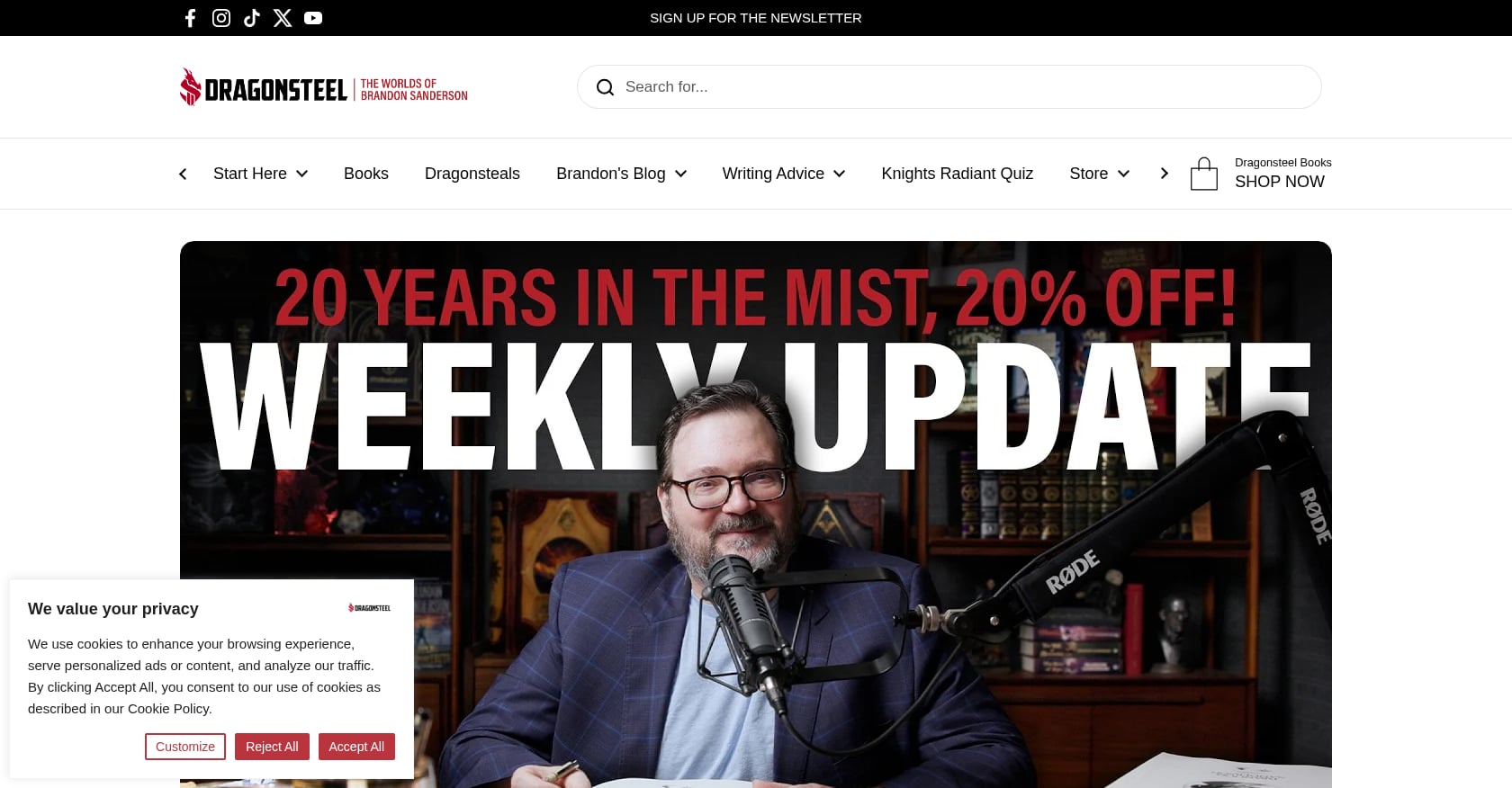
Best for: Fantasy and sci-fi authors with deep worlds and large catalogs
Brandon Sanderson’s site is an operations hub for a massive fandom. It features newsletter signup, store/cart integration, “Where Do I Start?” navigation, Cosmere explainers, free fiction, series pages, writing progress bars, film/TV news, and a blog. Visit brandonsanderson.com to see the full scope.
What to copy:
- Add a “Where should I start?” page for complex series
- Give readers free entry points into the world
- Use progress updates to keep fans engaged between releases
- Separate series and worlds clearly in navigation
Tradeoffs:
- Do not copy this complexity unless the author has a large backlist or an audience demanding it
- For a debut fantasy author, a simple “Start here” box and one series page is enough
- The store integration adds operational overhead (fulfillment, returns, customer support)
Practitioner perspective: Brandon Sanderson fan communities on Reddit show that readers use the official website and newsletter to verify release dates, free stories, signed copies, and canonical reading orders. The site functions as a trusted single source of truth for the fandom.
5. Colleen Hoover
Best for: High-demand commercial fiction authors with direct sales
Colleen Hoover’s homepage functions like a bookstore. Navigation covers About, Books, Shop, Sale, account/cart, signed bestsellers with add-to-cart buttons, and a “Where to Start?” reading order section.
What to copy:
- Offer signed copies if operationally feasible
- Add a reading order for large catalogs
- Make “add to cart” frictionless
- Sell gifts and merch only when demand exists
Tradeoffs:
- A shop-first website makes sense for a huge brand, not a debut author
- Managing inventory, tax, fulfillment, returns, and customer service is a real business
- Many authors should link to retailers instead of selling direct
Authors interested in signed or special-edition physical copies without warehousing inventory should explore print-on-demand options before committing to a full ecommerce setup.
6. Brené Brown
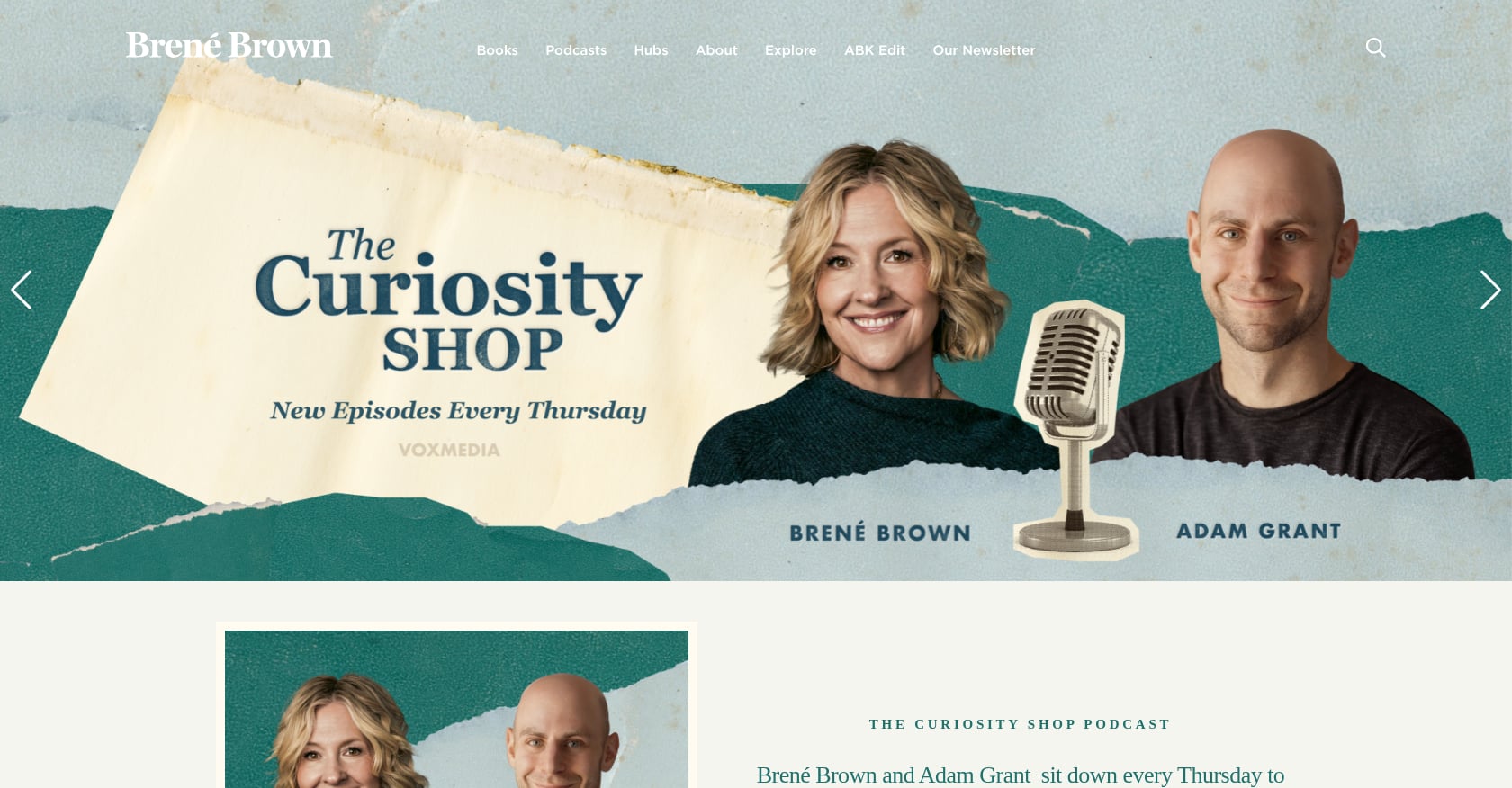
Best for: Nonfiction experts, speakers, and thought leaders
Brené Brown’s site is much bigger than a book page. It includes books, podcasts, research hubs, media contact and press kit, FAQ, articles, videos, newsletter, and retailer links organized by country.
What to copy:
- Nonfiction authors should think beyond “book” and include speaking, podcast, research, and resources
- Use a press kit or media contact page if PR is part of the strategy
- Create hubs around major books or frameworks
- Add global retailer links for international audiences
Tradeoffs:
- This is an enterprise-scale platform, not a template for debut authors
- A first-time business author can simplify the model to: book, about, speaking, media kit, resources, newsletter, contact
- Maintaining multiple hubs requires a team or serious editorial discipline
Authors building a press kit for the first time will find a publicity and marketing glossary helpful for understanding the terminology agents, reviewers, and podcast hosts expect.
7. Nita Prose
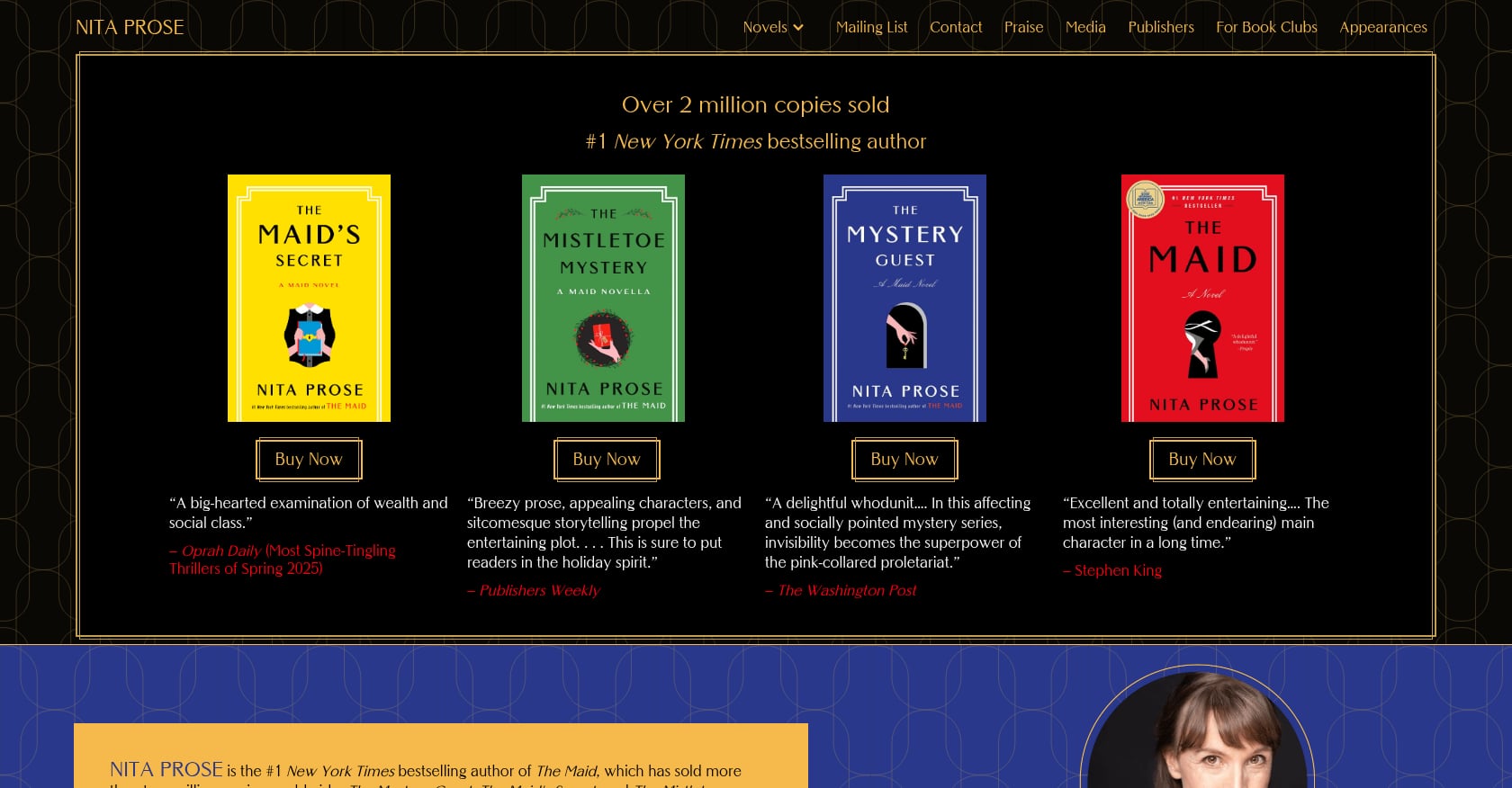
Best for: Book club-friendly fiction authors
Nita Prose’s “For Book Clubs” page offers downloadable book club kits for multiple titles, including discussion questions and reading group resources. It is a concrete, underused asset that supports libraries, clubs, and word-of-mouth discovery.
What to copy:
- Add book club questions and downloadable PDF kits
- Include author Q&A, discussion prompts, and thematic extras (recipes, playlists, maps)
- Make resources easy for librarians and club organizers to find and share
Tradeoffs:
- The resource page is useful but understated; email capture could be stronger alongside the downloads
- Pairing a kit download with a newsletter signup would increase retention
- This model works best for upmarket, literary, or discussion-friendly fiction
8. Judy Moody
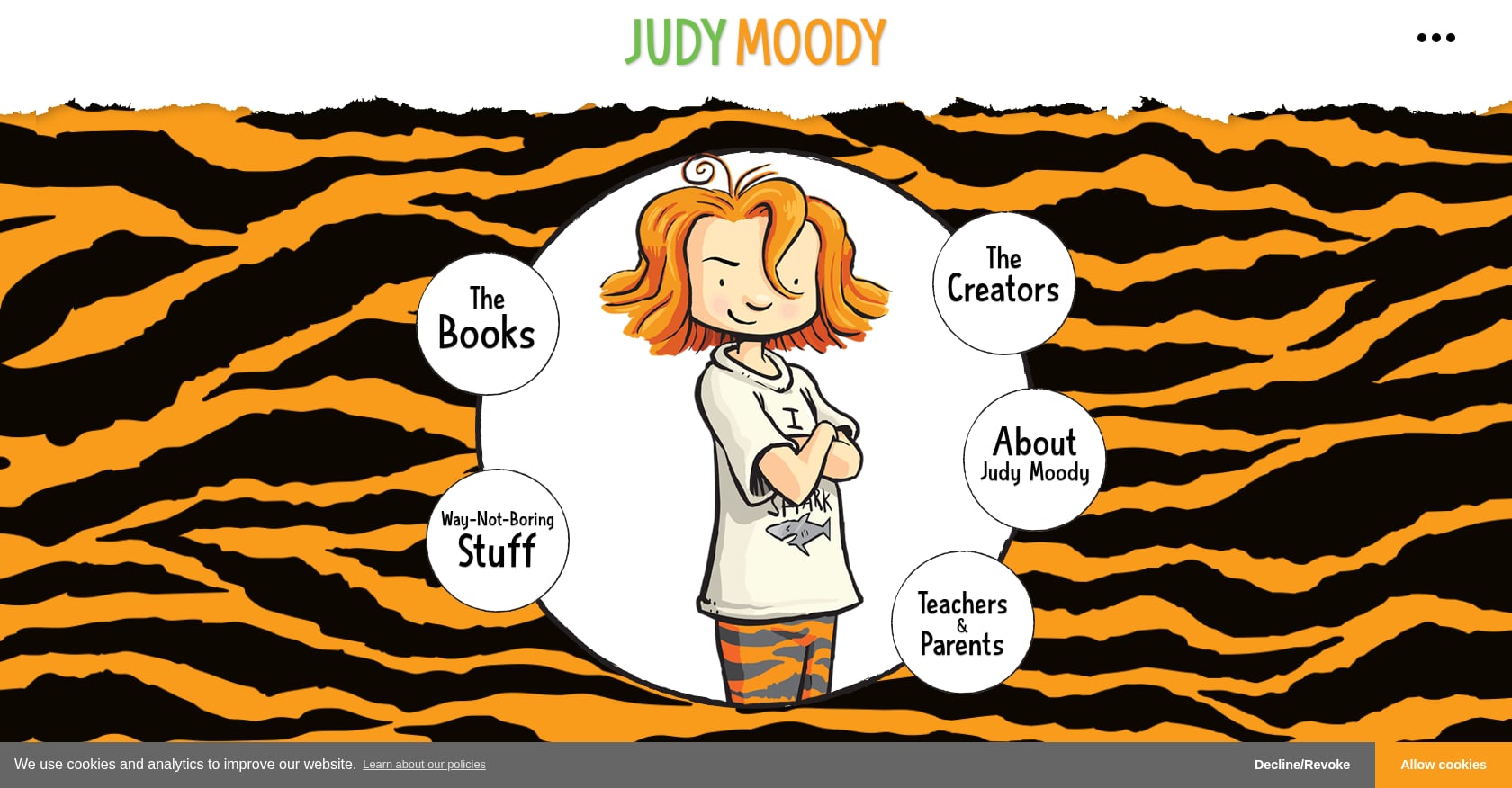
Best for: Children’s series and classroom engagement
The Judy Moody site uses audience-specific navigation: The Books, Way-Not-Boring Stuff, Teachers & Parents, About Judy Moody, and Creators. It serves kids, gatekeepers, and educators simultaneously, making it one of the best author website examples in the children’s space.
What to copy:
- Build for multiple audiences: child readers, parents, teachers, librarians
- Include activities, classroom resources, printables, and series pages
- Use playful naming that matches the book world
Tradeoffs:
- This is a series-brand site backed by a publisher’s resources, not a solo indie operation
- A debut children’s author can copy the audience segmentation without needing a full interactive world
- Teacher and parent resources take time to create but pay off in school visit bookings and bulk sales
If you are publishing a children’s book and need help with illustration, formatting, or distribution, children’s book publishing support is designed for that purpose.
9. Ali Hazelwood
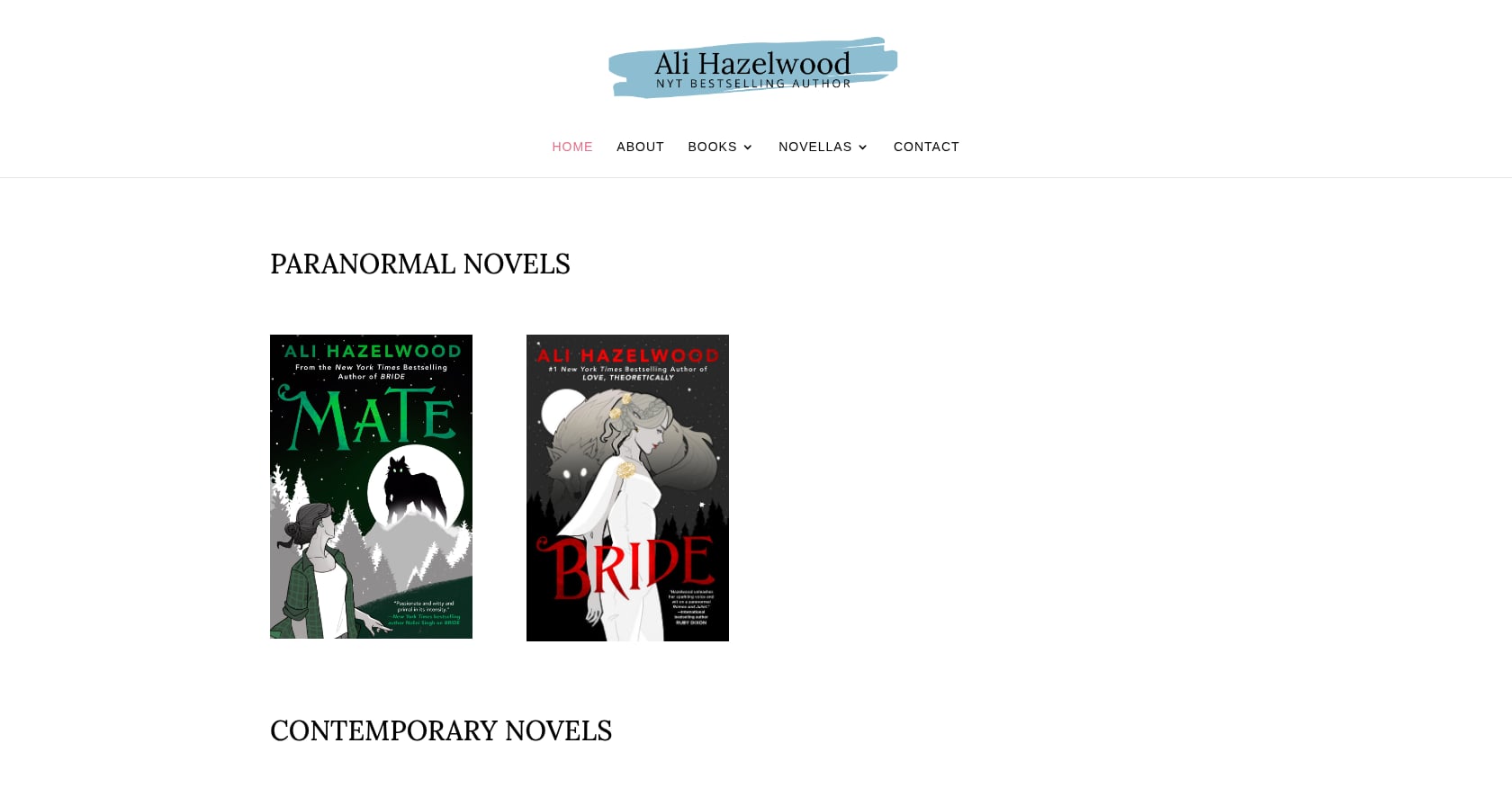
Best for: Romance authors with a growing catalog across subgenres
Ali Hazelwood’s homepage organizes books into paranormal novels, contemporary novels, paranormal novellas, and contemporary novellas. Social links and a newsletter promising exclusive content and early updates sit prominently on the page.
What to copy:
- Group books by subgenre and format when readers may enter through different tropes
- Use a newsletter promise that gives fans a clear reason to subscribe
- Place social links where active readers already congregate: Instagram, TikTok, Goodreads
Tradeoffs:
- Cover grids alone can feel thin without trope tags, heat level, or reading guidance
- Add “start here” recommendations for new readers who do not know which subgenre to try first
- Without supporting copy, a cover gallery looks attractive but does not convert browsers into buyers
10. Rupi Kaur
Best for: Poets, artists, and lifestyle-brand authors
Rupi Kaur’s site combines books, about, tour/events, shop categories (art, stationery, apparel), social channels, and a weekly branded newsletter called “unfinished.”
What to copy:
- Give the newsletter a branded name that reflects the author’s voice
- Let the site reflect the broader creative world, not just the books
- Sell books alongside art, stationery, or tour experiences if the audience supports it
Tradeoffs:
- The more the site becomes a shop, the more carefully it needs to preserve a clear book path
- Brand-world ecosystems require active management and inventory
- Poets and artists with small audiences should start simple before adding merch
11. Victoria Aveyard
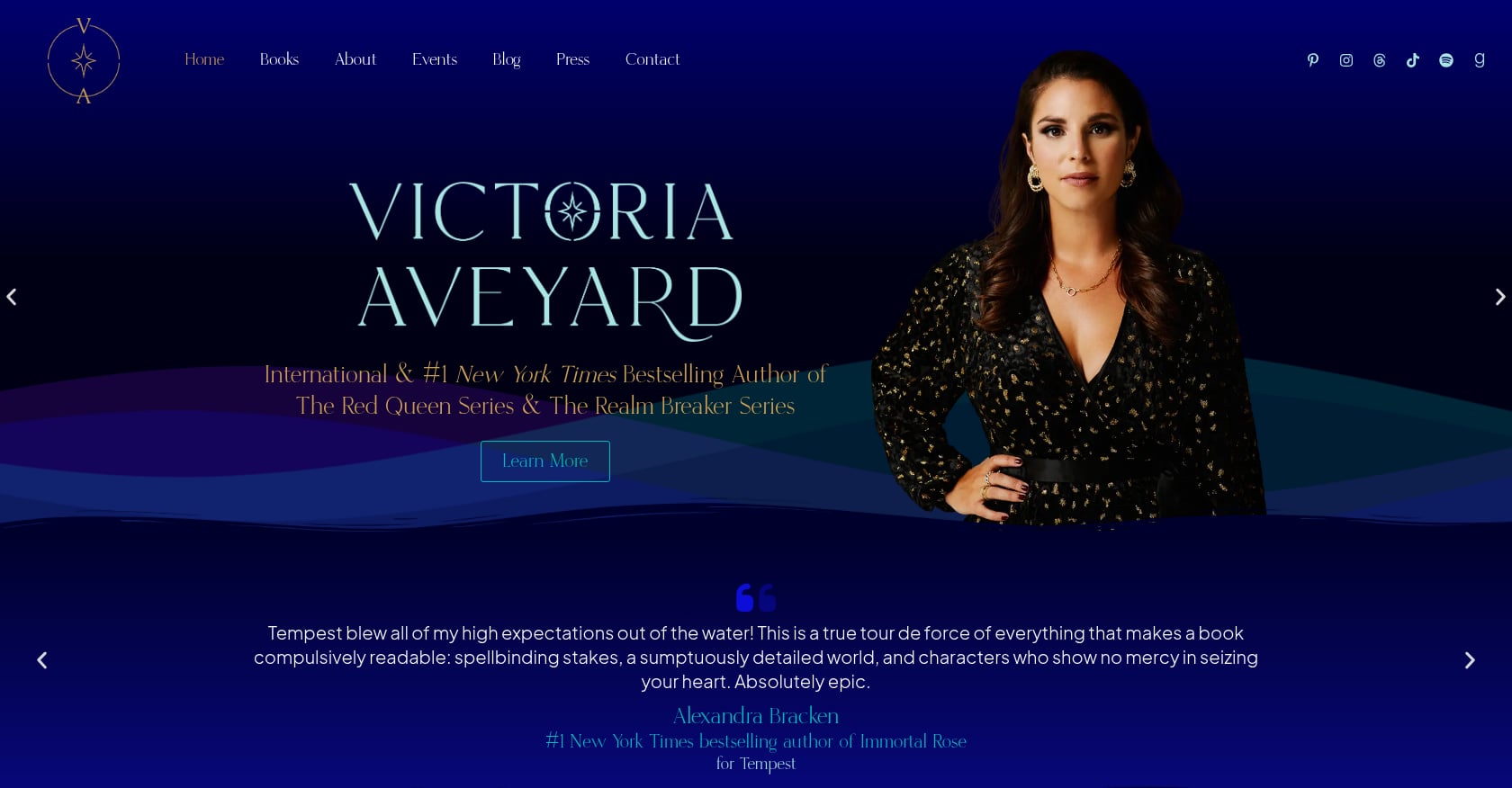
Best for: YA and fantasy authors launching a new release
Victoria Aveyard’s site leads with a clear bestseller credential, an upcoming release, preorder CTA, series sections, review blurbs, blog/news updates, social links, events, and a press/contact page.
What to copy:
- Use a single upcoming release as the main homepage focus
- Add a preorder CTA above the fold
- Organize older series below the current launch
- Use the strongest blurbs from recognizable authors or publications
Tradeoffs:
- Too much praise can overwhelm; curate the best blurbs for the homepage and relegate the rest to the book page
- Launch-focused sites need regular updates or they look abandoned
- The model works best when there is an active release to promote
12. Angie Thomas
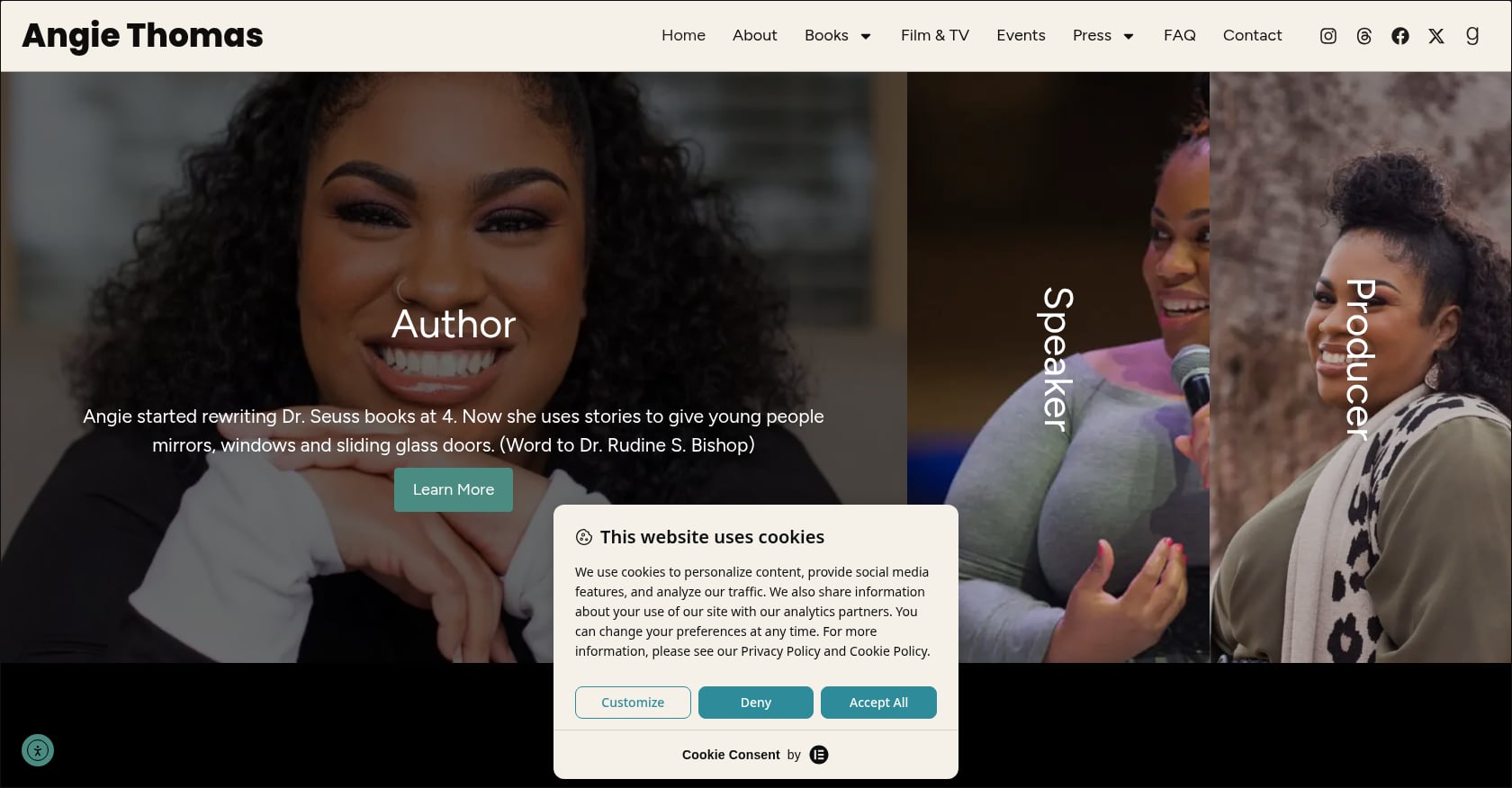
Best for: Authors with multiple professional roles (speaker, producer, advocate)
Angie Thomas’s homepage positions her as author, speaker, producer, and activist. The site includes books, film/TV news, events, press kit, FAQ, contact, teacher/reader resources, and a speaking inquiry CTA.
What to copy:
- If the author has multiple roles, name them clearly on the homepage
- Add a press kit for media inquiries
- Add teacher and reader resources for school-relevant books
- Include a speaking or event inquiry pathway
Tradeoffs:
- Multi-role positioning can dilute the book CTA if hierarchy is unclear
- Keep the current book or primary reader action prominent regardless of other roles
- A press kit is essential for authors seeking podcasts, PR, or speaking, but it takes real effort to build properly
13. Seth Ring
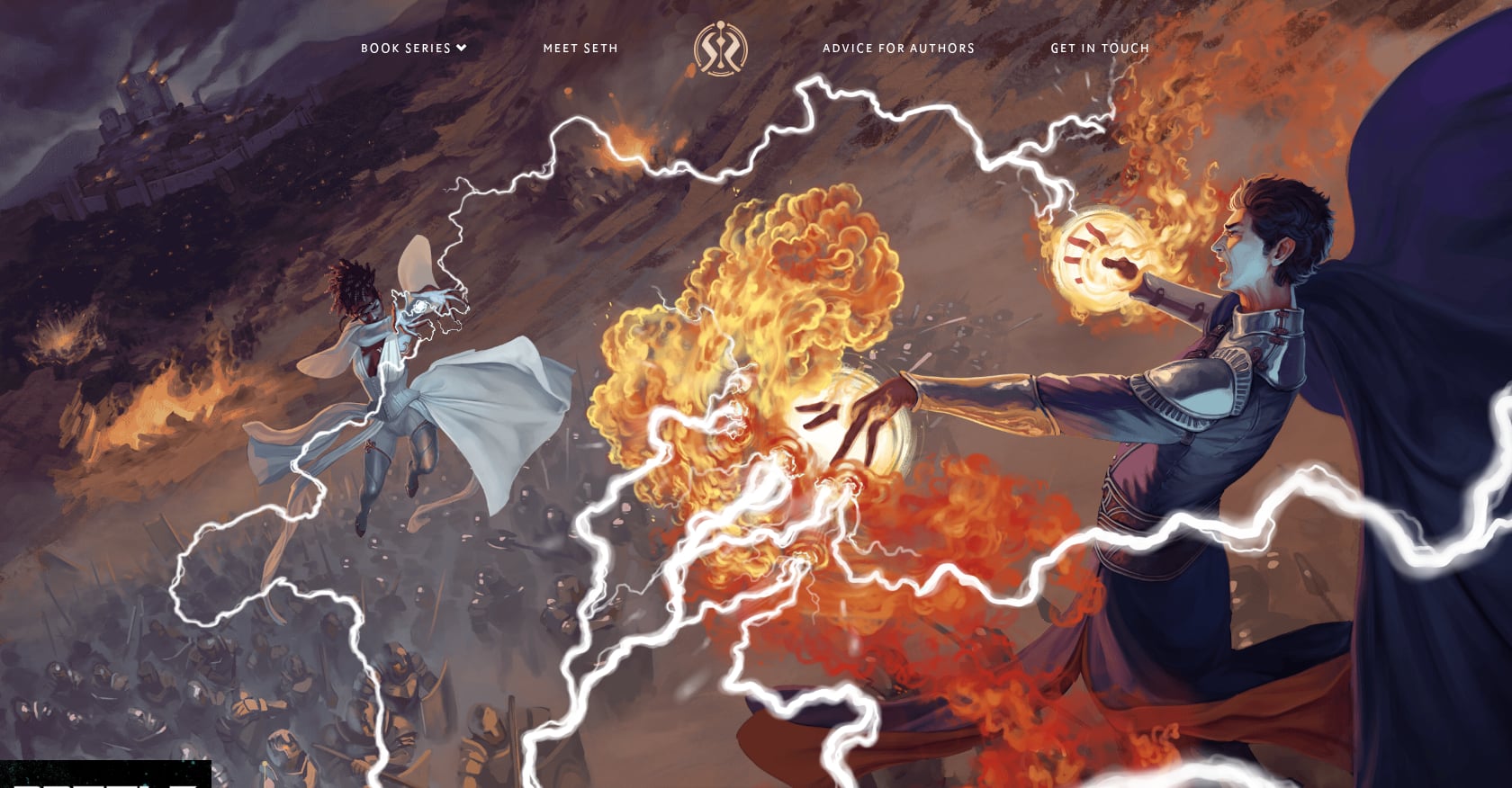
Best for: LitRPG, progression fantasy, and rapid-release serial authors
Seth Ring’s site foregrounds series navigation, an “Explore All Books” section, author intro, and an “Inner Ring” newsletter signup for releases and events.
What to copy:
- Use series-first navigation for genre readers browsing by world
- Create a branded fan newsletter name (“Inner Ring” is a good model)
- Provide clear browse paths by series
Tradeoffs:
- This approach assumes readers already know they want to browse a catalog
- New authors need more “why this series?” copy and stronger entry points for first-time visitors
- Without reading order guidance, series navigation can confuse more than it helps
14. Brit Bennett
Best for: Literary fiction authors with strong critical reception
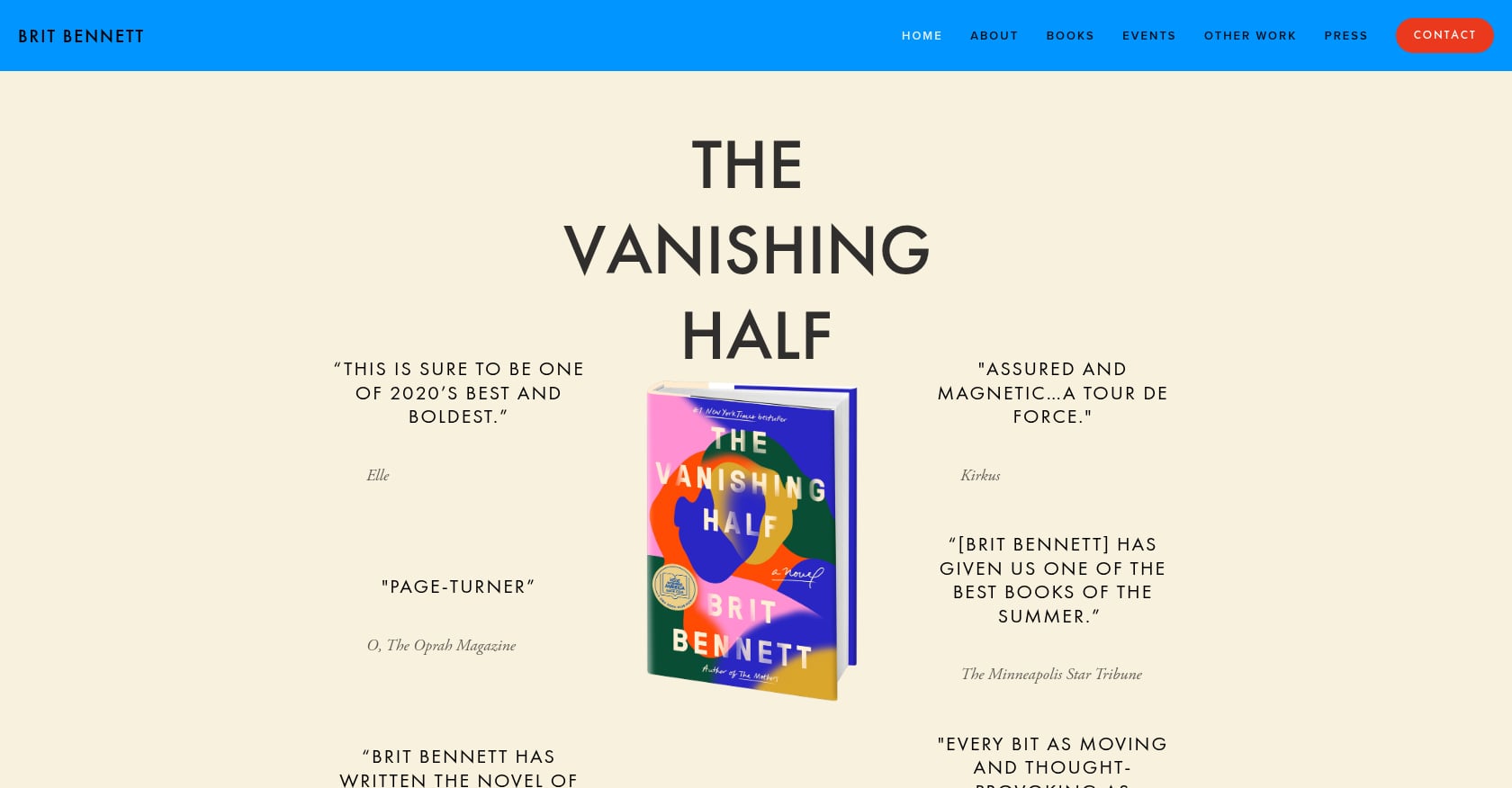
Brit Bennett’s site is clean, literary, and praise-forward. It foregrounds The Vanishing Half, review quotes from major publications, “Order Now” buttons, and a downloadable book club kit.
What to copy:
- Literary fiction sites can be spare if the social proof is strong
- Use review quotes as design elements, not afterthoughts
- Offer book club kits for discussion-friendly fiction
Tradeoffs:
- Minimal literary sites can feel static between releases
- Add a newsletter or event module if actively building a platform
- Without email capture, the site becomes a billboard that readers visit once and forget
How Much Does an Author Website Cost?
Cost is one of the biggest sources of confusion for authors building websites. Here is a realistic breakdown by tier.
Simple landing page (roughly $10 to $50 per year plus domain). Best for unpublished or debut authors who need a bio, book page, email signup, and contact form. Carrd Pro Standard costs $19 per year and includes custom domain URLs, forms, widgets, embeds, and analytics. Domain names typically run $10 to $20 per year.
DIY full author site (roughly $4 to $30 per month). Best for authors with one to five books who want multiple pages, blog, newsletter embeds, and buy links. WordPress.com offers a free plan and paid plans starting at $4 per month billed annually. Wix offers free sites with Premium plans that add custom domains and remove branding, though prices vary by location.
Professional author website ($500 to $5,000 or more). Best for authors who need a polished site before launch, have speaking or PR needs, or prefer not to learn web design. Practitioners on Reddit caution that “design” and “development” are separate skills, and one commenter estimated roughly $1,000 to $1,500 for a functional six-page author site. Treat that as community anecdote, not a universal price.
For a full picture of what self-publishing costs beyond the website, see this self-publishing budget breakdown.
What Pages Should Your Author Website Have?
BookBub’s author website checklist recommends published books, new releases, a subscription method, contact info, social links, events, optional blog, simple navigation, clean design, and mobile friendliness. Here is a practical page list organized by priority.
Essential (every author):
- Homepage with genre promise and current book
- Book page with cover, blurb, buy links, and format options
- About page with professional bio and headshot
- Newsletter signup with a real reason to join
- Contact form (not a public email address)
- Social links to active profiles
Important (most published authors):
- Reading order page for series
- Individual book pages for each title
- Events page if doing signings, festivals, or virtual appearances
- Audiobook page or audio retailer links if available
Authors with print and ebook links but no audio option can explore audiobook production and distribution to add another format and revenue stream.
Situational (depending on career stage):
- Media or press kit for podcast, PR, or speaking outreach
- Book club kits or educator resources
- Blog or news page (only if sustainable)
- Shop page for direct sales or merch
- Privacy policy and email compliance basics
Practitioners on Reddit advise that the site does not need to be advanced for new authors. One commenter in r/writers said a contact form, bio, and short book summary were enough at the querying stage, and noted that agents did visit their site during the process.
Common Author Website Mistakes
These mistakes come up repeatedly in author communities and across the best author website examples reviewed above.
No email capture. A beautiful site with no newsletter signup is a missed opportunity. Email remains one of the most reliable ways to reach readers without depending on social media algorithms.
Books buried below biography. Visitors came for the book, not a life story. Put the book above the fold or one click away.
Linking only to Amazon. If distributing wide, include links to Barnes & Noble, Apple Books, Kobo, and independent bookstores. Readers who prefer other platforms will leave rather than switch retailers.
No mobile testing. Google uses mobile-first indexing. If the buy buttons, signup forms, or navigation break on a phone, the site is functionally broken for most visitors.
Using a public email address instead of a form. Practitioners on Reddit favor contact forms over exposed email addresses because of spam and scam risk. One author reported receiving only a couple of spam messages through a contact form in five years.
Blogging without consistency. A blog with no posts in years signals neglect. If you cannot maintain it, use a news page or newsletter archive instead.
Copying a celebrity author’s site when you have one book. A debut author does not need Brandon Sanderson’s fandom operations center. Start with the smallest site that does the job, and expand as the catalog grows.
No reading order for series authors. This is one of the most underrated conversion assets. Readers who cannot figure out where to start will not start at all.
No media kit. Authors who want podcast appearances, speaking engagements, or press coverage need a downloadable press kit. Without one, opportunities go to authors who make the booker’s job easy.
Before You Publish: Author Website Checklist
Use this list before your site goes live.
- Current or most important book above the fold
- Buy or preorder links for multiple retailers
- Newsletter CTA with a real reader benefit
- Custom domain based on author name or pen name
- Professional bio and headshot on the about page
- Contact form, not a public email address
- Reading order if there are multiple books or series
- Book club kit or educator resources where relevant
- Media kit if seeking PR, podcasts, or speaking
- Audiobook links or audio retailer buttons if available
- Mobile responsive layout tested on phone and tablet
- Fast page load (compressed images, minimal heavy scripts)
- Social links to active profiles
- Privacy policy and email compliance
- Consistent genre voice in fonts, colors, and imagery
- Blog or news section only if you can keep it current
- All preorder dates and “coming soon” pages up to date
- Each book page has cover, blurb, reviews, buy links, and format options
- No broken links
- One clear CTA per page section
Your website is only one piece of the platform. If the publishing and launch pieces around it still feel scattered, professional book publishing packages cover editorial, cover design, ISBN setup, and distribution while you keep creative control and ownership of your work.
FAQ
Do authors still need websites?
Yes, but not because random readers will find you through Google. An author website is a controlled home base for books, bio, newsletter, contact, press, events, and reader resources. Practitioners on Reddit consistently frame it as a place to capture and retain readers who found the author elsewhere, through back matter, social media, ads, events, or recommendations.
What should an author website include at minimum?
A homepage, book page, about page, newsletter signup, contact form, social links, and buy links. Authors with more platform needs can add a media kit, events page, blog, reading order, book club kits, educator resources, and shop pages.
How much does it cost to build an author website?
A simple landing page can cost as little as $19 per year on Carrd plus a domain name. DIY sites on WordPress.com or Wix start at $4 to $17 per month depending on the plan. Professional design typically runs $500 to $5,000 or more depending on scope, integrations, and ecommerce needs.
Should an author website have a blog?
Only if the author can keep it useful and current. Blogs make sense for nonfiction experts, essayists, and authors whose ongoing content is part of the reader relationship. Fiction authors can often use a news page, newsletter archive, or bonus content section instead. A dead blog is worse than no blog.
Should authors put their email address on their website?
A contact form is usually safer than publishing a personal email address. Author communities on Reddit overwhelmingly favor forms because of spam and scam risk.
What lead magnet works best for author websites?
It depends on genre. Romance authors do well with bonus epilogues, deleted scenes, or prequel novellas. Fantasy authors can offer maps, lore guides, or prequel short stories. Nonfiction authors should consider a free chapter, worksheet, or email course. The key principle: offer something genuinely valuable in exchange for the email address, not just “updates.”
What is the best website builder for authors?
There is no universal answer. Carrd works for simple landing pages. WordPress.com handles content-heavy sites. Wix and Squarespace work for visual DIY builds. Custom builds suit authors with complex ecommerce, membership, or media needs. Match the platform complexity to your career stage and technical comfort.
Can I build an author website before my book is published?
Yes. An early site with a bio, genre description, contact form, and mailing list signup is better than nothing. Agents and early readers may visit it. Keep it simple and expand once the book has a cover and release date.