May 4, 2026
12 Best Publishing Companies for First Time Authors (2026)
Publishing Companies for First Time Authors: 12 vetted 2026 options—traditional, hybrid, and DIY—with pricing, royalties, and pros/cons. Pick yours.
TL;DR
First time authors have three realistic paths in 2026: traditional publishers that accept unagented submissions, hybrid publishers that charge upfront for trade distribution, and DIY platforms paired with professional services. The right choice depends on your budget, timeline, and how much control you want. This guide covers 12 vetted options with current pricing, royalty math, and honest tradeoffs so you can pick the path that fits your book, not just your ambition.
At-a-Glance Comparison Table
| Option | Approach | Upfront Cost | Royalty/Earnings | Distribution | Best For |
|---|---|---|---|---|---|
| Alpaca Authors | DIY + services studio | $497–$3,497 (publishing) | Author retains rights; earnings via KDP/Ingram | 40+ stores globally | First timers wanting pro help + full control |
| Amazon KDP | DIY platform | $0 | 50–70% (ebook); 50–60% (paperback) | Amazon global | Amazon-focused launches on a tight budget |
| IngramSpark | DIY platform (wide print) | $0 setup | 85% of net revenue | 40,000+ retailers/libraries | Bookstore and library distribution |
| Draft2Digital | Aggregator (ebook + POD) | $20 activation | ~45% list minus print (POD) | Wide ebook + print via Ingram/Amazon | One-dashboard wide distribution |
| Lulu | POD + direct store | $0 setup | 80/20 split (Lulu store) | Lulu store + Ingram retail | Direct-to-consumer and special formats |
| Blurb | Photo-centric POD | Varies by format | Via Ingram to retailers | Ingram wholesale | Illustrated and photo books |
| She Writes Press | Hybrid | $12,000 | Varies (see FAQ) | Trade distribution | Women authors seeking curated hybrid support |
| Greenleaf Book Group | Hybrid | Custom (premium) | Varies | Trade distribution | Business/nonfiction authors with a platform |
| Kensington Publishing | Traditional | $0 (submission) | Advance + royalties | Full trade | Genre fiction (romance, mystery, westerns) |
| Baen Books | Traditional | $0 (submission) | Advance + royalties | Full trade | Science fiction and fantasy |
| Holiday House | Traditional | $0 (submission) | Advance + royalties | Full trade | Children’s and YA |
| TCK Publishing | Independent | $0 (submission) | 50% gross (advertised) | Publisher-managed | Nonfiction with a clear problem-solving angle |
How to Choose Your Path Before Your Publisher
Most first time authors start by searching for a company name. That’s backwards. The smarter move is to pick your publishing path first, then find the right partner within that path.
Jane Friedman’s widely referenced publishing paths framework breaks things into three broad lanes, and those lanes haven’t changed in 2026, even as specific platforms have shifted their policies.
Traditional publishing means a publisher pays you. They cover editing, design, printing, and distribution. You get an advance against royalties, and the publisher takes on financial risk. The tradeoff: you give up significant creative control, the timeline stretches 12 to 24 months, and most houses require a literary agent. A handful still accept unagented submissions (more on those below).
Hybrid publishing means you pay the publisher. A legitimate hybrid provides editorial curation, professional production, and trade distribution, but you fund the process. The IBPA hybrid publisher criteria define what separates a real hybrid from a vanity press: vetted manuscript acceptance, professional editing, trade distribution, and transparent financials. If a company publishes anything you send as long as you pay, it’s not a hybrid. It’s a print shop with a marketing budget.
DIY platform + services means you publish through a platform like KDP or IngramSpark and hire professionals for the parts you can’t do yourself: editing, cover design, formatting, marketing, and audiobook production. You keep all rights, earn the highest per-unit royalties, and bear full responsibility for quality and visibility.
Here’s a simple decision framework:
- Budget over $10,000 and want curated distribution? Consider a reputable hybrid like She Writes Press or Greenleaf.
- Budget under $5,000 and want rights plus creative control? Use a services studio like Alpaca Authors layered on top of KDP and IngramSpark.
- Writing genre fiction and agent-ready? Query a few unagented-friendly traditional presses while parallel-planning a self-publishing backup.
If you’re still figuring out the nuts and bolts of preparing your manuscript, resources like this guide to creating a book glossary can help you think through the production details most debut authors overlook.
The 12 Best Publishing Companies for First Time Authors (2026)
1. Alpaca Authors
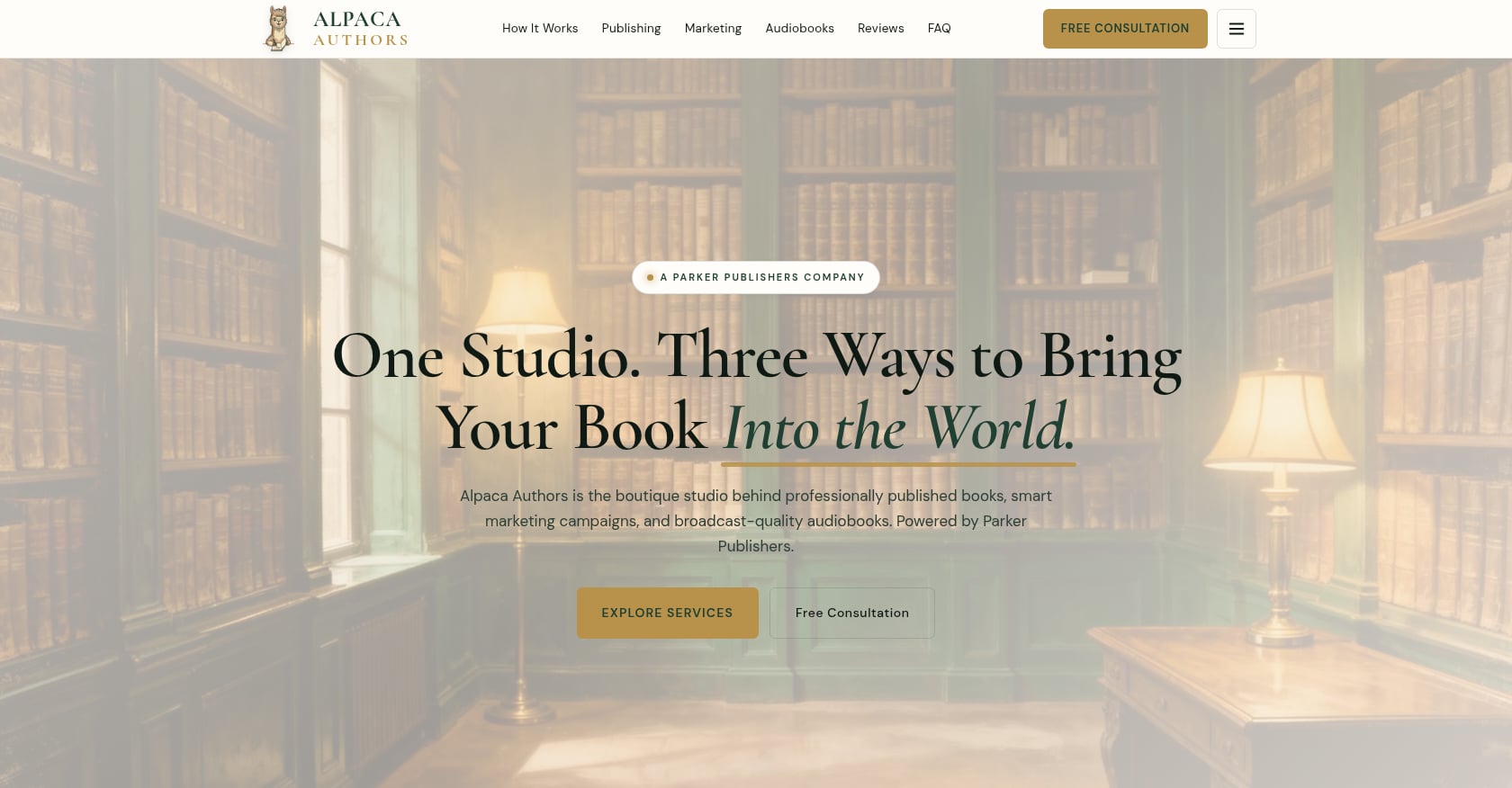
Best for: First time authors who want professional production, marketing, and audiobook support while retaining full rights and creative control.
Alpaca Authors is a boutique services studio (a Parker Publishers company) that bundles publishing, marketing, and audiobook production under one roof. Rather than acting as your publisher, Alpaca acts as your team, handling the professional work while you publish through platforms like KDP and IngramSpark and keep your intellectual property.
Pricing:
- Publishing packages: $497 (The Pasture) to $3,497 (The Alpaca), covering editorial, custom cover design, ISBN/metadata setup, and distribution to 40+ platforms
- Marketing packages: $997 to $4,997/month, including Amazon Ads, social campaigns, PR, email, and newsletter placements
- Audiobook packages: $1,497 to $6,997, covering narrator casting, studio recording, mastering, and distribution to 45+ listening platforms
Key features:
- Genre-aligned cover design that meets retailer specs and improves ad click-through rates
- Multi-store distribution enablement (Amazon, Barnes & Noble, Apple Books, IngramSpark, and more)
- Named points of contact rather than ticket-based support
- Upfront pricing with no hidden upsells
Tradeoffs:
- Not a traditional publisher; there are no advances, and the author funds production and marketing
- Boutique capacity can affect timelines during peak seasons
- Marketing outcomes depend on genre fit and ad budget
Who should look elsewhere: Authors seeking a traditional publishing deal with an advance, or those who want to handle every step themselves to minimize costs.
2. Amazon KDP
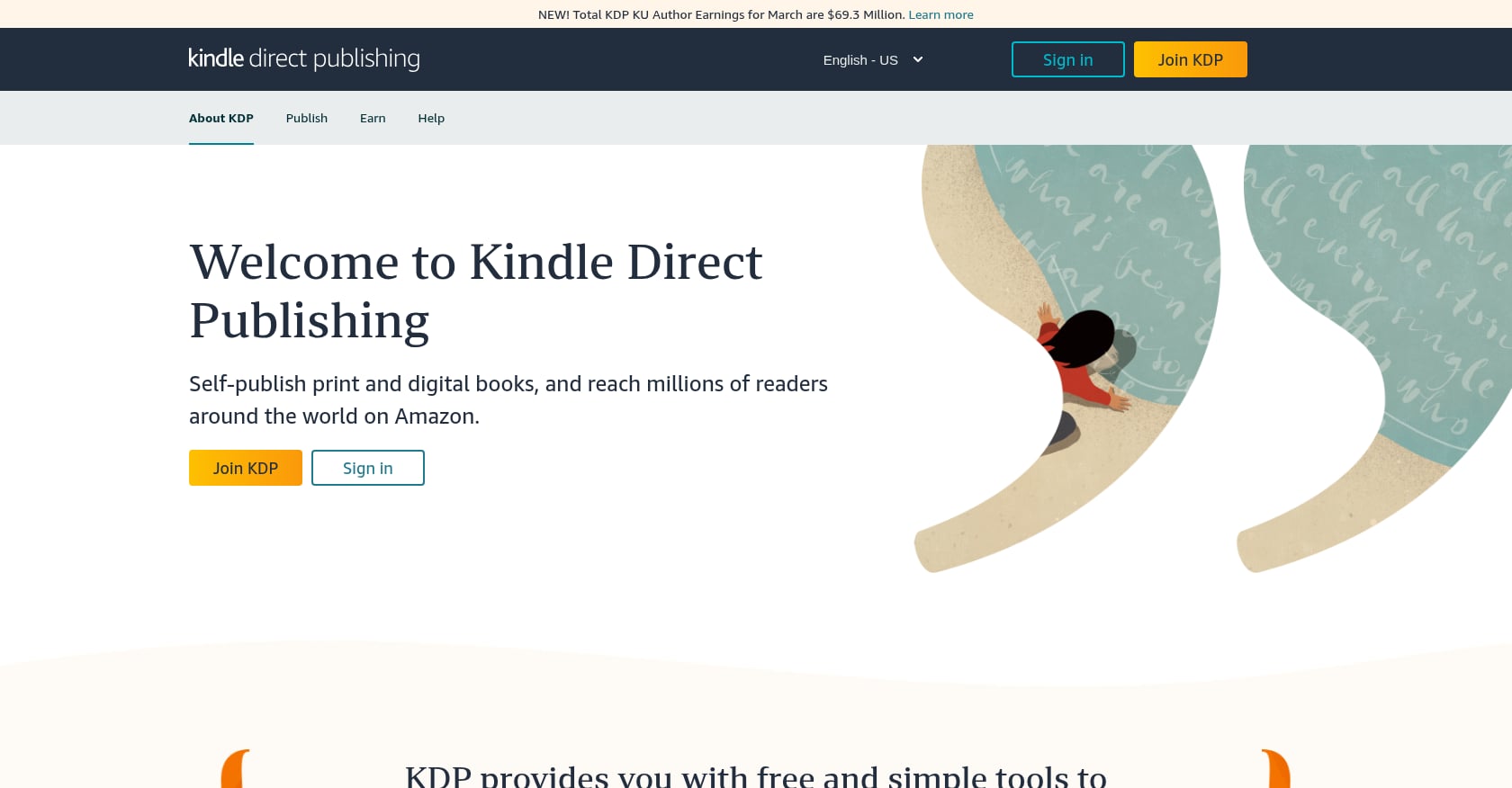
Best for: Amazon-centric launches with zero upfront cost, especially text-heavy ebooks and standard black-and-white paperbacks.
Amazon KDP remains the default starting point for most first time authors, and for good reason: it costs nothing to publish and gives you access to the world’s largest bookstore.
Pricing: $0
Royalties:
- Ebooks: 70% or 35% depending on price and territory, with a per-MB delivery fee deducted at 70%
- Paperbacks: 50% or 60% on Amazon sales depending on list price thresholds (see the 2026 changes section below); 40% on expanded distribution
- All print royalties are calculated after subtracting printing costs
Key features:
- Instant publishing to all Amazon marketplaces
- Kindle Unlimited enrollment (optional, requires ebook exclusivity)
- Free ISBN for paperbacks (Amazon-assigned)
- Real-time sales reporting
Tradeoffs:
- Limited bookstore reach unless paired with IngramSpark
- KU exclusivity locks your ebook out of Apple, Kobo, and other retailers
- Practitioners on Reddit report that the delivery fee math matters more than most guides admit: comic and illustrated ebook authors sometimes earn more at the 35% tier because the per-MB delivery charge erodes the 70% rate on image-heavy files
Worked example: A 300-page paperback listed at $14.99 (U.S.) with a $4.85 print cost earns ($14.99 × 60%) − $4.85 = $4.14 per copy on Amazon. Drop the list price to $9.98 and the royalty rate falls to 50%, netting ($9.98 × 50%) − $4.85 = $0.14. That ten-cent difference between $9.98 and $9.99 is worth knowing.
3. IngramSpark
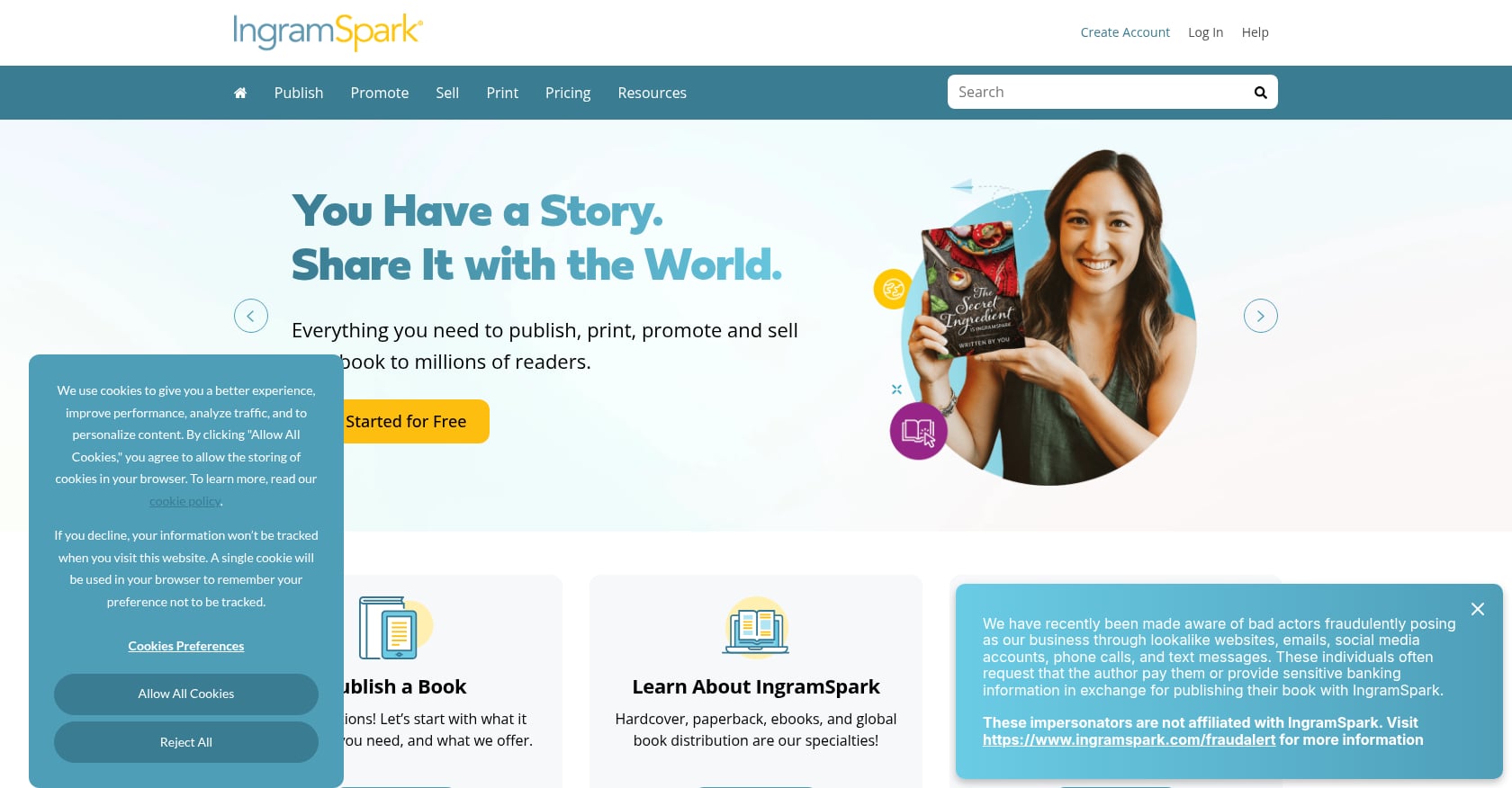
Best for: Wide print distribution to bookstores, libraries, and universities, especially for authors who want their paperback or hardcover stocked beyond Amazon.
IngramSpark connects your book to the same wholesale network that traditional publishers use. If a bookstore or library wants to order your title, Ingram is how that order gets fulfilled.
Pricing: Free setup; revision fees are typically free within 60 days, then $25 per change. Authors earn 85% of the net revenue IngramSpark receives on each sale.
Key features:
- Access to 40,000+ retailers and library systems globally
- Hardcover, paperback, and ebook distribution
- Publisher-grade trim sizes and binding options
- Returnability settings that affect bookstore willingness to stock
Tradeoffs:
- Listings take 2 to 6 weeks to appear at retailers, so do not panic-edit metadata daily during that window
- Wholesale discount and returns settings directly affect your margin. Set the discount too low and bookstores won’t order. Set returns to “yes” and you absorb the cost of unsold copies.
- Practitioners on Reddit describe IngramSpark’s backend dashboard as confusing, with occasional print quality inconsistencies
Pro tip: Many authors use KDP for Amazon sales and IngramSpark for everywhere else. This “KDP + Ingram” split is the most common strategy discussed in self-publishing communities, and it works well as long as you disable IngramSpark’s Amazon listing to avoid competing with your own KDP edition.
4. Draft2Digital
Best for: Authors who want wide ebook distribution and simple print-on-demand without managing multiple dashboards.
Draft2Digital (D2D) is an aggregator. You upload your manuscript once, and D2D distributes your ebook to Apple Books, Kobo, Barnes & Noble, and dozens of other retailers. Their D2D Print service also routes paperbacks through Ingram and Amazon channels.
Pricing: No per-title fees for core distribution and conversion. However, D2D introduced new fees in 2026: a $20 one-time activation fee for new accounts and a $12 annual maintenance fee if your trailing 12-month net earnings fall below $100. PayPal payout fees up to 2.5% (capped) also apply.
Key features:
- One-click distribution to major ebook retailers worldwide
- Free formatting and conversion tools
- Universal book links for marketing
- D2D Print for paperback distribution
Tradeoffs:
- The aggregator cut reduces per-sale earnings compared to going direct on each platform
- D2D Print pays roughly 45% of list price minus print cost, lower than KDP’s direct rates
- Authors on Reddit note the new maintenance fee is nudging very-low-volume writers to delist titles or go direct on individual stores. Heavier sellers remain unaffected.
5. Lulu
Best for: Direct-to-consumer sales and special print formats like coil-bound or certain hardcover configurations.
Lulu operates its own bookstore and offers print-on-demand with direct integrations into Shopify and WooCommerce, making it a solid pick for authors who want to sell from their own website.
Pricing: Free to set up. On Lulu Bookstore sales, the gross profit split is 80% to the creator and 20% to Lulu for print (90/10 for ebooks). For global retail distribution via Ingram, retailers take roughly 50% of the list price before Lulu’s split applies.
Key features:
- Lulu Bookstore with direct-to-reader purchasing
- Shopify and WooCommerce integrations for author websites
- Unusual format options (coil binding, landscape, etc.)
- Retail distribution via Ingram when eligible
Tradeoffs:
- Retail distribution economics are much less favorable than selling on Lulu’s own store
- Sales reporting for retail channels can lag 6 to 8 weeks
- Practitioners on Reddit note that color printing through Lulu can be expensive, though quality is often praised for certain formats
6. Blurb
Best for: Photo books, art books, and heavily illustrated projects where visual quality matters more than per-unit cost.
Blurb is built for visual content. It offers premium print options and distributes through Ingram to retailers, but its real strength is producing beautiful physical objects rather than maximizing royalties on trade paperbacks.
Key features:
- Premium paper stocks and binding options for photo/art books
- Trade book and magazine formats available
- Ingram distribution for retail listings
- Integration with Adobe tools for layout
Tradeoffs:
- Higher unit costs make it impractical for standard text-heavy books
- A recent independent review criticized color reproduction and binding durability, so ordering proofs before committing to a print run is essential
- Not designed for ebook-first publishing strategies
7. She Writes Press
Best for: Women authors who want a curated, selective hybrid publishing experience with trade distribution and are willing to invest $12,000 or more upfront.
She Writes Press is one of the most frequently cited examples of a legitimate hybrid publisher. They vet manuscripts before acceptance, provide professional editing and design, and distribute through traditional trade channels. Authors retain their rights.
Pricing: A single all-inclusive publishing package listed at $12,000 as of January 2026, with separate marketing packages available.
Key features:
- Manuscript curation (not all submissions accepted)
- Professional editorial, design, and production
- Trade distribution through traditional channels
- Author retains rights
Tradeoffs:
- The $12,000 price tag is a serious commitment for a debut author with no guarantee of sales
- Royalty and fee structures differ from DIY platforms and should be reviewed carefully in the publisher’s handbook
- Practitioners on Reddit consider She Writes Press one of the stronger hybrids, but insist on understanding the contract before signing
8. Greenleaf Book Group
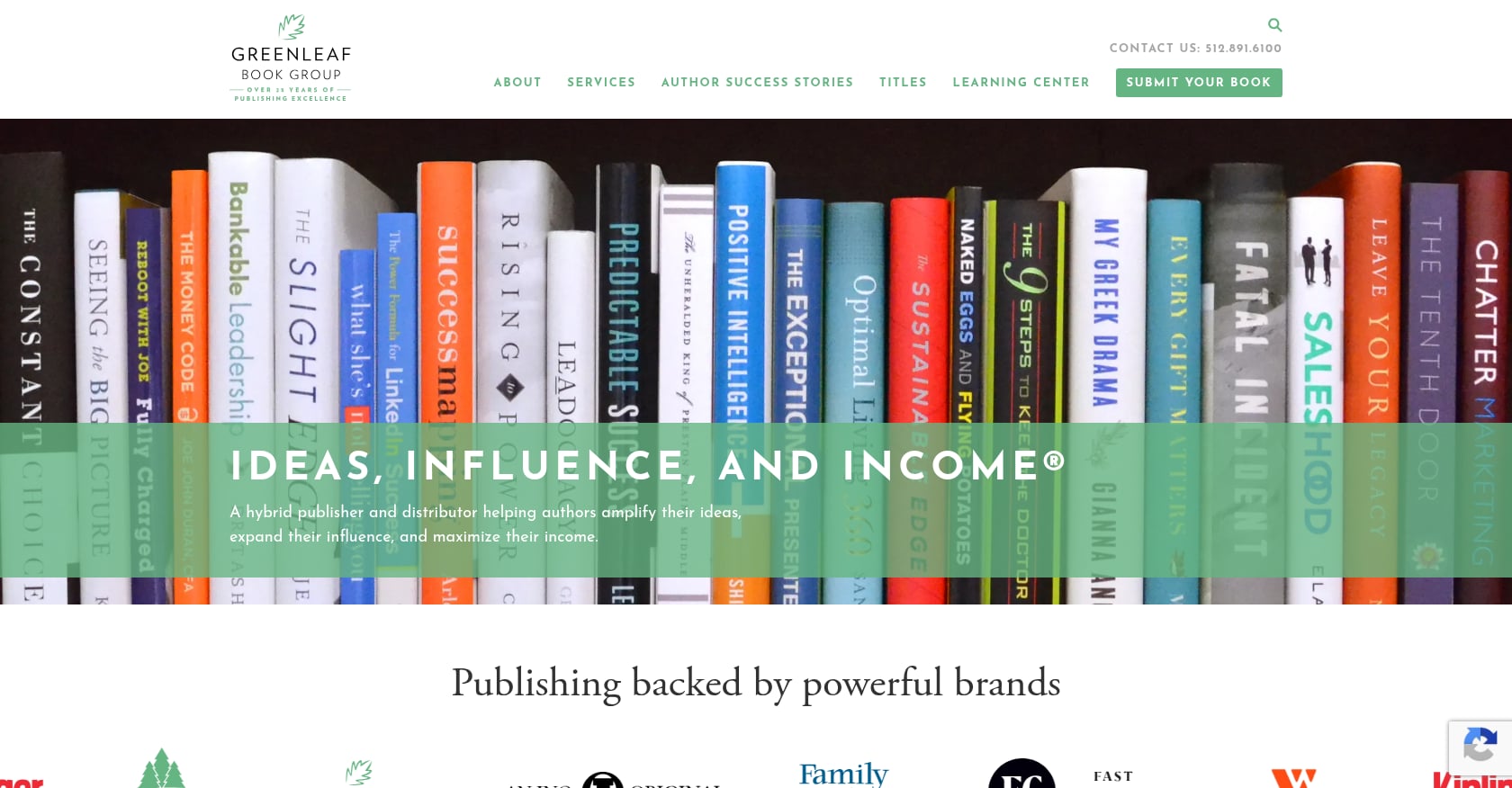
Best for: Business and nonfiction authors with an existing platform who want premium production and genuine trade distribution.
Greenleaf is a selective hybrid publisher and distributor that focuses on nonfiction, particularly business, leadership, and lifestyle categories. In 2025, Greenleaf was acquired by Civica Media (BlackBern Partners), which signals institutional backing but also potential operational changes worth monitoring.
Key features:
- Curated acceptance process
- Premium production values
- Trade distribution through established channels
- Focus on platform-driven nonfiction
Tradeoffs:
- Premium investment (custom pricing, typically five figures)
- ROI depends heavily on the author’s existing audience and willingness to promote
- Mixed community sentiment, with some authors questioning value relative to assembling your own team
- Recent acquisition means policies and staff may shift
9. Kensington Publishing Corp
Best for: Genre fiction authors (romance, mystery, westerns, select nonfiction) pursuing a traditional deal without a literary agent.
Kensington is one of the largest independent traditional publishers in the U.S. and one of the few that still accepts unagented queries in specific categories. They provide editor contacts and submission instructions directly on their website.
Key features:
- Traditional publishing deal with advance and royalties
- Publisher covers all production and distribution costs
- Strong backlist presence in genre categories
- No agent required for certain imprints
Tradeoffs:
- Highly competitive; rejection is the most likely outcome
- Not all imprints accept unagented work, so check current submission guidelines carefully
- Decision timelines can stretch months
- You cede significant creative control over cover design, pricing, and marketing
10. Baen Books
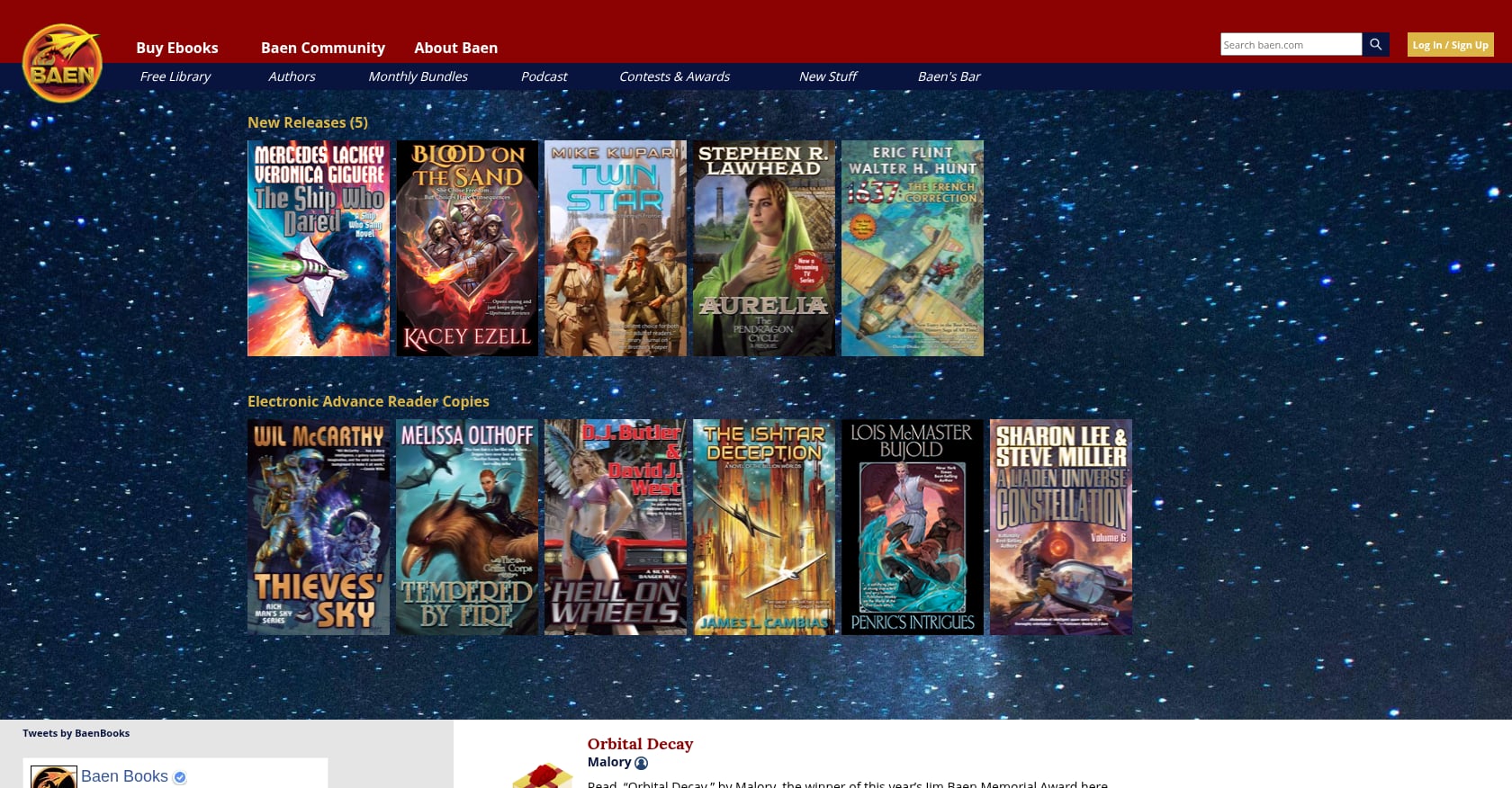
Best for: Science fiction and fantasy debut authors targeting a storied genre press that accepts manuscripts directly.
Baen is one of the few established SFF publishers that still takes unagented submissions through an online form. For debut authors writing hard science fiction, military SF, or epic fantasy, it’s a legitimate shot at a traditional deal.
Key features:
- Established SFF publisher with a loyal readership
- No agent required
- Traditional publishing deal if accepted
Tradeoffs:
- Extremely narrow genre fit
- Long submission queue and high bar for acceptance
- Limited to science fiction and fantasy
11. Holiday House
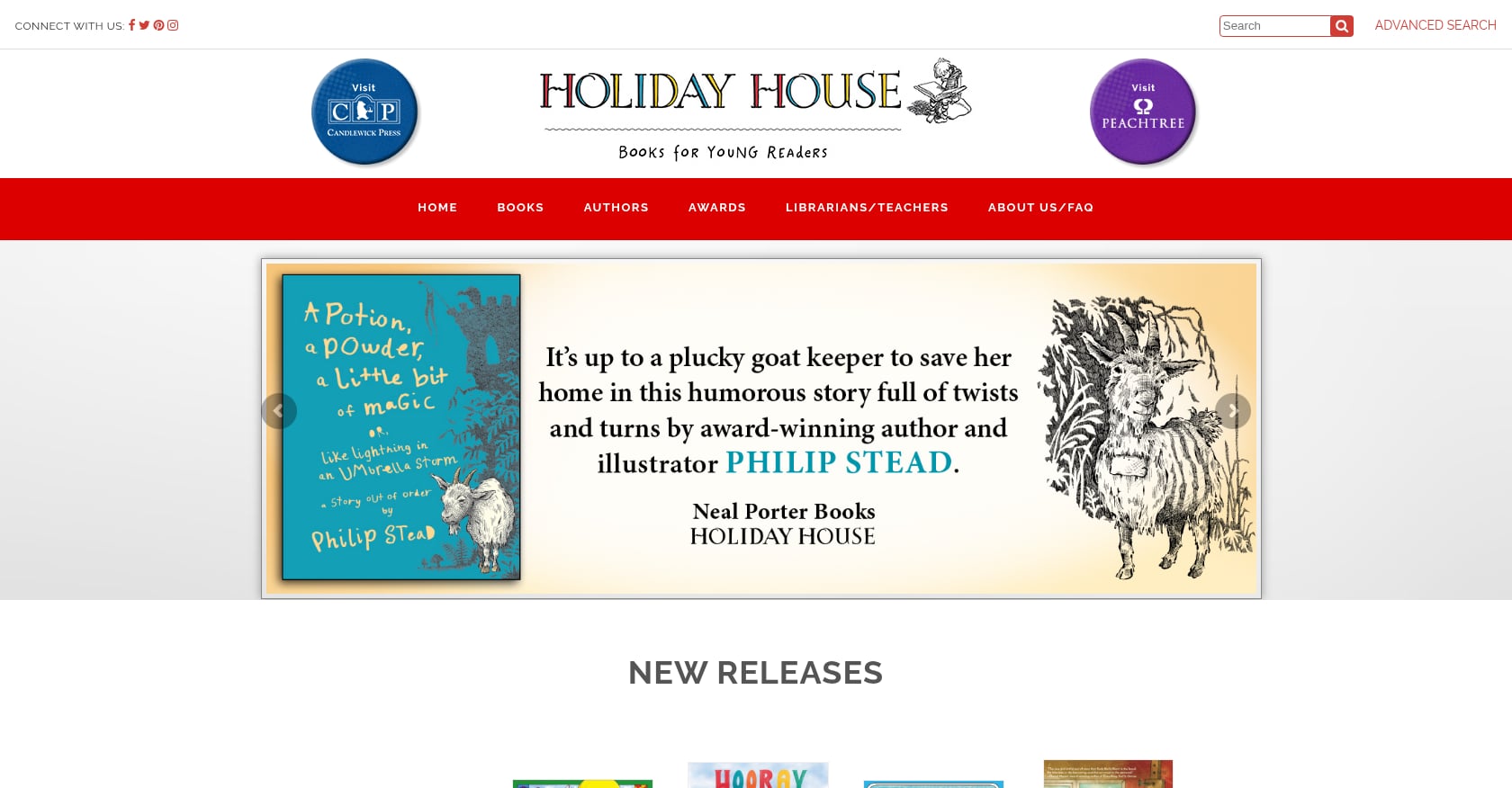
Best for: Debut children’s and YA authors ready to query a traditional publisher directly without an agent.
Holiday House has been publishing children’s books since 1935 and accepts unagented submissions via email. Their catalog spans picture books through young adult, with strong seasonal publishing programs.
Key features:
- Respected children’s and YA imprint
- No agent required
- Traditional deal structure
Tradeoffs:
- Highly selective
- Genre and age-range alignment is critical
- Expect long response times
12. TCK Publishing
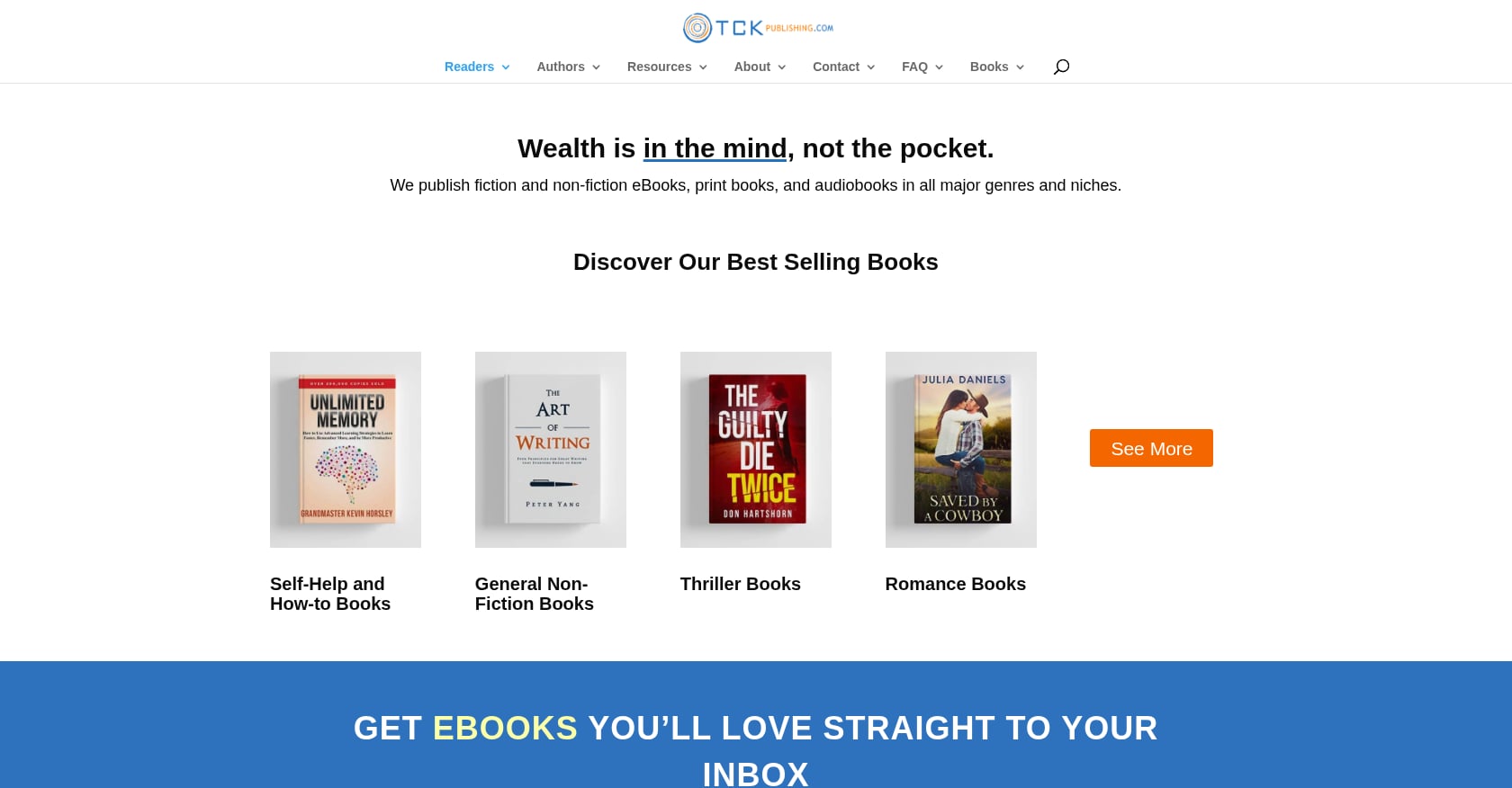
Best for: First time nonfiction authors with a clear problem-solving concept who want a traditional-style deal without paying fees.
TCK Publishing is a small independent press that accepts unagented nonfiction proposals with no author fees. They advertise 50% gross royalties and publish only a small fraction of submissions. Fiction submissions are currently closed.
Key features:
- No author fees
- Advertised 50% gross royalties
- Nonfiction focus with editorial support
Tradeoffs:
- Very limited slots and low acceptance rate
- Verify the royalty basis and marketing expectations in the contract before signing
- Currently closed to fiction
2026 Policy Changes That Affect First Time Authors
Two platform-level changes this year directly affect the economics of publishing for first time authors.
KDP’s new paperback royalty bands. Amazon KDP now pays either 50% or 60% royalty on paperback sales, depending on your list price. In the U.S., paperbacks priced at $9.99 or above earn 60%. Below that threshold, you earn 50%. Expanded distribution (non-Amazon channels) remains at 40% regardless. The practical implication: ultra-low paperback pricing to attract bargain readers can cost you ten percentage points on every sale. Run the numbers in KDP’s royalty calculator before finalizing your price.
Draft2Digital’s new fee structure. D2D introduced a $20 one-time activation fee for new accounts and a $12 annual maintenance fee that kicks in if your trailing 12-month net earnings through D2D stay below $100. Existing accounts skip the activation fee. Maintenance fees start on May 14, 2026, pegged to your account anniversary. If you’re only selling a handful of copies through D2D, the math may no longer work. Consider delisting low-earning titles or going direct on individual storefronts instead.
These changes reinforce a broader pattern: platforms that were once completely free are introducing friction for low-volume users. First time authors should factor ongoing fees into their financial planning, not just upfront costs.
Whichever publishing path you choose, the marketing responsibility increasingly falls on you. Even traditionally published debut authors are expected to promote their own work. If you’d rather have someone manage your Amazon Ads, social campaigns, and launch strategy, book marketing services designed for authors can fill that gap without requiring you to become a part-time digital marketer.
How to Vet Any Publishing Company in 10 Minutes
The publishing industry for first time authors is full of companies that look legitimate at first glance. Here’s a quick checklist you can run through in about ten minutes before signing anything.
-
Check IBPA hybrid criteria. If a company calls itself a hybrid publisher, verify it meets the Independent Book Publishers Association’s standards: editorial curation, professional production, trade distribution, and financial transparency. A company that accepts every manuscript as long as you pay is a vanity press.
-
Run it through ALLi Watchdog. The Alliance of Independent Authors maintains a service ratings database that flags predatory companies and rates legitimate ones. Ten seconds of searching can save you thousands.
-
Verify distribution claims. “Available in 40,000 stores” often means “listed in Ingram’s catalog,” which any IngramSpark author can achieve for free. Ask specifically: will bookstores actually order and stock my book, or is it just technically orderable?
-
Read the contract for rights reversion. How long does the publisher hold your rights? Under what conditions can you get them back? If the answer is “never” or “after 7 years with conditions,” walk away unless the deal is genuinely worth it.
-
Understand returns and wholesale discounts. Mis-set wholesale discounts (below 40% for bookstores, for example) mean retailers won’t stock you. Accepting returns means you absorb the cost of unsold inventory. These settings have real financial consequences.
-
Search Reddit for the company name plus “reviews” or “complaints.” Community forums surface patterns that polished testimonials never will. Recent threads have flagged everything from surprise fees to aggressive upsell tactics.
Red flags to watch for: Pressure to buy marketing add-ons immediately after signing, “book-to-film” pitches with no verifiable track record, contracts that claim subsidiary rights in perpetuity, and pricing that increases dramatically after an initial “discount.”
What Most Publishing Guides Won’t Tell You
After reading dozens of listicles about publishing companies for first time authors, a few important realities tend to get glossed over.
Print quality varies within the same platform. IngramSpark and KDP both use print-on-demand, and the output can differ between print facilities. Authors in self-publishing forums report that POD quality from IngramSpark is generally perceived as higher than KDP for certain trim sizes, but inconsistencies happen. Always order a proof copy from the actual production facility, not a one-off sample.
Fees creep in after setup. The initial publishing cost is rarely the final cost. IngramSpark charges $25 for revisions after 60 days. D2D now charges maintenance fees for low earners. KDP deducts delivery fees on image-heavy ebooks. None of these are deal-breakers, but they add up if you’re not tracking them.
Listing timelines are slower than you expect. Books uploaded to IngramSpark take 2 to 6 weeks to appear at retailers. Amazon is faster, often 24 to 72 hours. If you’re planning a coordinated launch, account for these gaps.
Paperback and hardback margins can trap you. A $16.99 hardcover with a $9.50 print cost and a 55% wholesale discount leaves you with almost nothing. Run exact numbers before committing to a format. Hardcovers look prestigious on a shelf but can be financial losers for debut authors without established demand.
Audio is no longer optional for many genres. Audiobook consumption continues to grow, and skipping the format means leaving money on the table. If you’re weighing whether to produce an audiobook, this guide to self-publishing audiobooks breaks down the costs and distribution options.
Next Steps for First Time Authors
The number of publishing companies available to first time authors in 2026 is larger than ever. That abundance is both a gift and a trap, because more options mean more opportunities to spend money on the wrong thing.
Start with your path. If you want creative control and professional results without giving up your rights, the DIY-plus-services approach gives you the best combination of quality and ownership. If you want the validation and distribution muscle of a traditional house, target the unagented-friendly publishers on this list while building your self-publishing plan in parallel.
For debut authors who want professional editing, cover design, formatting, and distribution handled as a package, Alpaca Authors’ book publishing services offer tiered packages starting at $497 with distribution to 40+ stores. You keep your copyright, you keep your creative control, and you get a named team instead of a ticket queue.
And if your book is ready but your marketing plan isn’t, Alpaca Authors’ marketing packages cover Amazon Ads, social media, PR, and newsletter placements starting at $997 per month.
Publishing your first book is a milestone. Make sure the company you trust with it earns that trust.
Frequently Asked Questions
Can I publish a book with no money?
Yes. Amazon KDP and IngramSpark both allow you to publish with zero upfront cost. You’ll handle your own editing, cover design, and formatting, which means the quality depends entirely on your skills or willingness to learn. The “free” path works, but professional production usually shows in reviews and sales.
Do I need a literary agent to get published traditionally?
Not always. Kensington, Baen Books, Holiday House, and TCK Publishing all accept unagented submissions in specific categories. However, the acceptance rates are low, and having an agent generally opens doors to the Big Five publishers and better contract terms.
What’s the difference between a hybrid publisher and a vanity press?
A legitimate hybrid publisher curates submissions (rejecting some), provides professional editing and design, offers trade distribution, and operates with financial transparency, per the IBPA hybrid criteria. A vanity press publishes anything you send as long as you pay. The distinction matters because vanity presses often deliver poor production quality and no real distribution.
How much does it cost to self-publish a book in 2026?
Platform fees can be $0 (KDP, IngramSpark setup). Professional services range from a few hundred dollars for basic formatting to $3,000 or more for a full publishing package including editorial, design, and distribution. Marketing is additional. Audiobook production ranges from $1,500 to $7,000 depending on length and narrator quality.
Should I use KDP, IngramSpark, or both?
Many successful indie authors use both: KDP for Amazon sales (where most online book purchases happen) and IngramSpark for bookstores, libraries, and non-Amazon retailers. Just make sure to disable IngramSpark’s Amazon channel to avoid listing conflicts.
What are KDP’s 2026 paperback royalty rates?
KDP now pays 50% or 60% on Amazon paperback sales, determined by your list price. In the U.S., books priced at $9.99 or above qualify for the 60% tier. Expanded distribution pays 40% regardless of price. All rates are calculated after subtracting printing costs.
Is Draft2Digital still free in 2026?
Core distribution and conversion remain free, but new accounts now pay a $20 activation fee, and accounts earning less than $100 per year face a $12 annual maintenance fee starting May 2026. For moderate-volume authors, these fees are negligible. For authors with only one or two slow-selling titles, they’re worth considering.
How long does it take to publish a book as a first time author?
On KDP, you can go from upload to live listing in 24 to 72 hours. IngramSpark listings take 2 to 6 weeks to populate at retailers. Traditional publishers typically take 12 to 24 months from acceptance to bookshelf. Hybrid timelines vary but generally fall between 6 and 12 months. The fastest path is always DIY, but speed without quality rarely pays off.