October 6, 2026
What Is a Book Flap? Meaning, Parts, Copy (2026 Guide)
Learn what a book flap is, dust jacket parts, what to put on front and back flaps, and how to write flap copy. Get practical 2026 tips—start here.
TLDR
A book flap is the folded panel of a dust jacket that tucks inside the front or back cover of a hardcover book. The front flap typically carries the book description (called “flap copy”), while the back flap usually holds the author bio and photo. Not every hardcover has flaps, and the term often gets mixed up with related concepts like blurb, jacket copy, and back-cover copy. This guide explains the physical part, the marketing copy, and what self-publishing authors need to know before sending files to print.
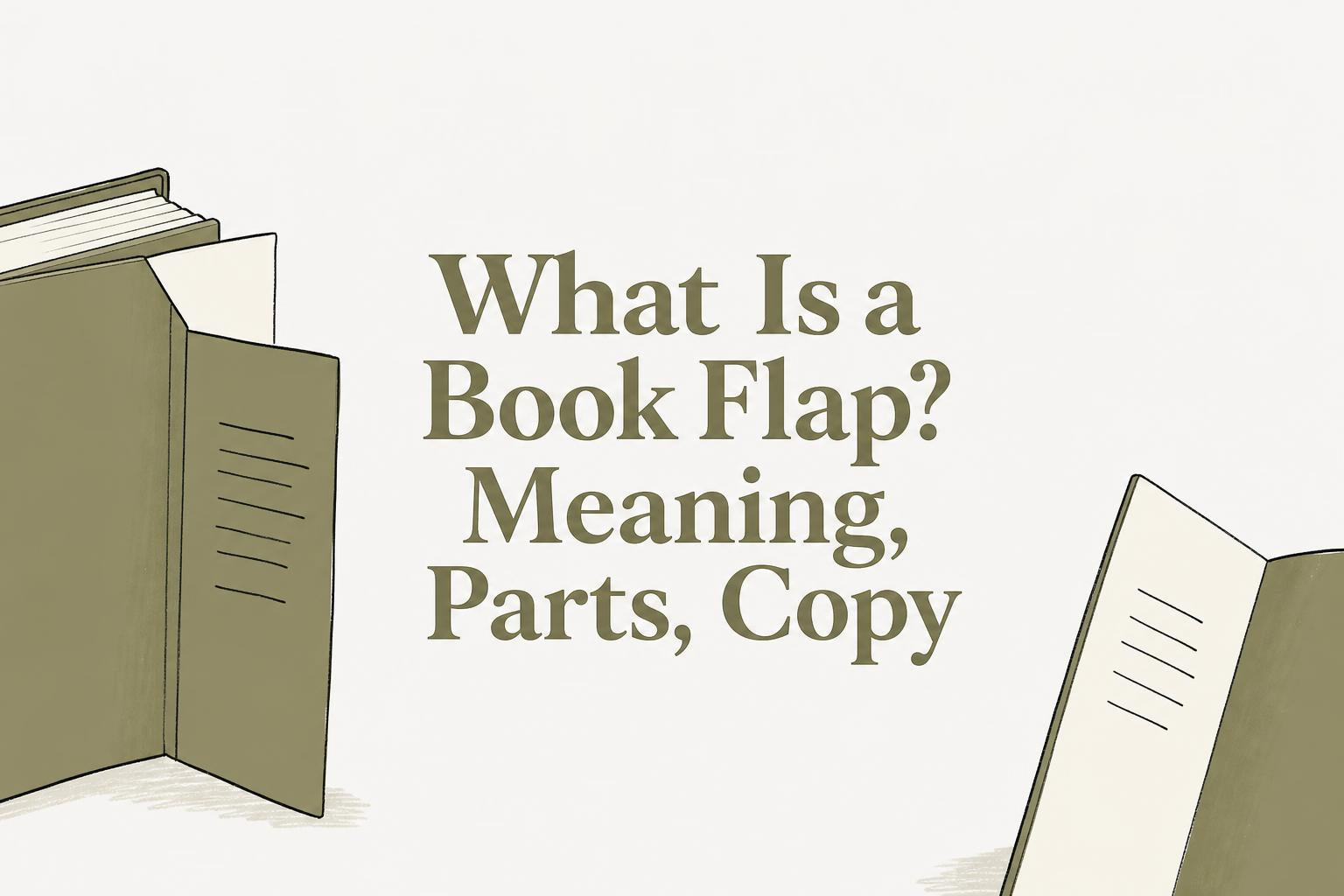
A book flap is one of the folded panels of a dust jacket that wraps around the front or back cover of a hardcover book. The front flap often carries the book description, or “flap copy,” while the back flap often includes the author bio, photo, praise, or series information.
That sounds simple enough. But the term causes real confusion because authors use “book flap” to mean two different things: the physical paper panel and the promotional text printed on it. If you’re preparing a hardback or paperback edition, both meanings matter.
This guide covers the anatomy, the terminology, the writing, and the production details so you can handle book flaps with confidence.
Explore Alpaca Authors’ book publishing services
Book Flap Definition
A book flap is the folded part of a dust jacket that wraps around the inside of a hardcover book’s front or back cover. Dust jackets are detachable paper covers printed with text and illustrations, and their folded flaps help hold the jacket in place while giving the publisher extra space for promotional text, author information, or design elements.
Every dust jacket has two flaps:
- Front flap: folds around the inside of the front cover
- Back flap: folds around the inside of the back cover
The flaps are not the same thing as the dust jacket itself. The dust jacket is the entire removable wrap. The flaps are just the two side panels that fold inward.
Front Flap vs. Back Flap
These two panels serve different purposes. Here is what typically goes on each one.
| Part | Location | Common Content |
|---|---|---|
| Front flap | Folded panel inside the front cover | Book description, hook, tagline, genre signal, series number |
| Back flap | Folded panel inside the back cover | Author bio, author photo, praise quotes, series information, website |
One important note: these are conventions, not rules. Practitioners on Reddit point out that some books put the blurb on the back cover instead of the front flap, while others use the flaps mostly for visual design. Layout flexibility is the norm, not the exception.
Book Flap vs. Dust Jacket vs. Flap Copy
Publishing terminology overlaps constantly. Authors on r/selfpublish frequently ask whether back-cover copy, flap copy, jacket copy, and blurb all mean the same thing. They don’t, though the boundaries are fuzzy.
| Term | Meaning |
|---|---|
| Dust jacket | The full removable printed wrap around a hardcover book, including front, spine, back, and two flaps |
| Book flap | One folded panel of the dust jacket (front flap or back flap) |
| Flap copy | Text printed on a dust-jacket flap, usually the book description |
| Jacket copy | Text printed on a hardcover jacket or paperback cover, often the same content as flap copy |
| Back-cover copy | Sales description on the back of a book, most common on paperbacks |
| Blurb | Ambiguous: can mean a praise quote from another author OR a short book description, depending on who is using the word |
| Synopsis | A fuller plot summary, often written for agents and editors, usually includes spoilers |
The blurb confusion deserves special attention. Lambda Literary defines a blurb as promotional copy on book covers or dust jackets that may include testimonials. But many indie authors use “blurb” to mean the book description. When someone says “write your blurb,” ask which kind they mean.
What Goes on a Book Flap?
Front Flap Content
The front flap is your book’s handshake with the reader. Common elements include:
- Hook line: a one-sentence pitch that creates immediate curiosity
- Short book description: enough to signal premise, protagonist, and conflict for fiction, or problem and promise for nonfiction
- Genre or category signal: the description’s tone should tell readers what kind of book this is
- Tagline: optional, but effective when short and specific
- Series number: if the book belongs to a series, readers need to know where it fits
The goal is not to summarize the entire plot. Good front-flap copy opens a question. It gives readers enough to want more and then stops.
Back Flap Content
The back flap is quieter but still important. It often includes:
- Author bio: a short paragraph connecting the author’s background to the book’s subject or genre
- Author photo: standard for most traditionally published hardcovers
- Endorsements or reviews: if you have praise from recognizable names
- Series information: especially useful for ongoing series with loyal readers
- Website or social handle: if appropriate and the design allows it
If you need help writing the bio itself, a guide on how to write an author bio can save you time and give you a working template.
What If You Don’t Have Reviews?
This is a real problem for first-time authors. One self-publishing author on Reddit asked what to put on an empty jacket flap when they had no notable endorsements. Community suggestions included using a strong tagline, a tantalizing story quote, or a clean author bio rather than filling the space with praise from people nobody recognizes.
The principle is simple: empty space or clean design is better than weak filler. A forgettable endorsement from someone readers have never heard of does nothing for trust. A sharp tagline or a well-chosen excerpt does more work.
How Long Should Flap Copy Be?
There is no universal word count because the actual limit depends on your book’s trim size, flap width, font size, and leading. But practical ranges give you a starting point:
- Front flap description (adult books): roughly 150 to 200 words
- Front flap description (children’s books): often no more than 100 words
- Back flap author bio: around 40 to 75 words
These numbers come from publishing guides and print-service recommendations. But always check with your designer or printer. The design controls the final fit, not the other way around. Writing 300 words for a flap that can only hold 160 means either cutting your copy or shrinking the type to an unreadable size.
Who Writes Flap Copy?
Traditional Publishing
In traditional publishing, the author rarely writes flap copy from scratch. Children’s book author Avi has explained that his editor usually drafts flap copy and sends it to him for revision. Editor Amy Einhorn has described flap copy as a marketing tool, noting that her team sometimes realized late in the process that the pitch needed to change before the hardcover jacket went to print.
Children’s book editor Joy Peskin has also pointed out that catalog copy (written for booksellers and buyers) serves a different audience than flap copy (written for consumers). Reusing one for the other can miss the mark.
Self-Publishing
Self-published authors usually write their own flap copy, hire a copywriter, or ask an editor to draft it. One practical tip comes from author Eliza Osborn, who shared on LinkedIn that she hired an author-friend to write her jacket copy because she wanted someone not too close to the manuscript to summarize it without overpromising.
This is worth taking seriously. Authors are often too deep inside their own book to write the sharpest sales pitch. Even asking a trusted reader to describe your book in two sentences can produce better raw material than staring at a blank flap.
Get professional editorial and cover design support
How to Write Flap Copy
Fiction Formula
A reliable structure for fiction flap copy follows this pattern:
When [inciting incident] happens to [protagonist], they must [goal] before [stakes], but [main obstacle] stands in the way.
Example:
Clara Bell has spent ten years pretending her family’s orchard is ordinary. Then a stranger arrives with her father’s missing watch and a warning: the trees remember every bargain ever made beneath them. To save the land before harvest night, Clara must uncover which promise her family broke and what the orchard plans to collect.
Why it works: it names the protagonist, introduces the inciting incident, signals genre and tone, raises stakes, and stops before spoilers.
Practitioners on Reddit’s r/writing recommend studying the top 100 books in your genre and using a protagonist, inciting incident, goal, and obstacle structure. Lead with conflict, not backstory. Use present tense for immediacy.
Nonfiction Formula
For nonfiction, the formula shifts toward the reader’s problem:
For [reader] struggling with [problem], this book offers [promise] through [method], so they can [desired outcome].
Example:
New managers are often promoted for being good at the work, then left alone to lead the people doing it. This practical guide shows first-time leaders how to run clearer meetings, give useful feedback, handle conflict early, and build trust without copying bad management habits.
Book coach Karen Anderson argues on LinkedIn that writing jacket copy before drafting the manuscript can clarify the reader, message, hook, and business goal. Flap copy doesn’t have to be a last-minute chore. It can be a planning tool.
The “Open Loop” Rule
Flap copy should open a question, not close it.
- Open: “Can she expose the killer before the town crowns him mayor?”
- Closed: “She exposes the killer and saves the town.”
For nonfiction:
- Open: “This book shows why your launch plan keeps stalling and how to fix it.”
- Closed: “After reading, you will know every tactic inside.”
The open version creates curiosity. The closed version removes the reason to read. If your flap copy is working properly, the reader feels a gap between what they know and what they want to know.
Book Flaps in Self-Publishing
This is where many authors get confused. Not every printing platform supports dust jackets, which means not every hardcover will have book flaps.
Platform Comparison
| Platform | Dust Jacket with Flaps? | Notes |
|---|---|---|
| Amazon KDP hardcover | No | KDP hardcovers are case laminate, meaning art prints directly on the cover. No dust jackets or cloth-bound formats available. |
| IngramSpark hardcover | Yes, on supported options | Offers jacketed case laminate and digital cloth options. Cover templates include flap areas. Some setups require two PDFs: one for the hardcover and one for the dust jacket. |
| Lulu dust-jacket hardcover | Yes | Lulu provides a template showing how to design flaps plus front and back covers. |
| Offset or custom printer | Usually yes | Specs vary. Request a jacket template before starting design. |
If you’re publishing through KDP and wondering why there’s no flap option, this is why. KDP hardcovers do not have dust jackets. Many authors discover this after assuming “hardcover” automatically means “jacketed.” If you want flaps, you’ll need IngramSpark, Lulu, or a custom printer. For a deeper breakdown of Amazon’s platform, see this KDP self-publishing glossary.
One more detail worth knowing: a hardcover edition with a dust jacket is considered a separate product format. That means it needs its own ISBN, distinct from your paperback or ebook edition.
Print File Checklist
Before sending a dust-jacket cover file to your printer, run through this list:
- Confirm your trim size and final page count first (spine width depends on page count)
- Download your printer’s dust-jacket template, including flap dimensions
- Finalize all flap copy before the designer starts layout
- Use CMYK color mode and 300 ppi resolution
- Respect bleed, fold, and safe zones marked on the template
- Leave space for the barcode and ISBN where required
- Keep text at least 0.25 inches from the trim line or board edge
- Proofread the flaps at 100% size on screen
- Order a physical proof before approving the full print run
- Double-check spine width after your final page count is locked
IngramSpark’s file requirements specify that a complete cover PDF must include front cover, back cover, spine, and flaps if the cover is a dust jacket, with 300 ppi, CMYK, barcode area, and proper bleed. Changing flap copy after layout is done means rework. Lock the text before design begins.
Book Flap Copy vs. Amazon Book Description
Authors on r/selfpublish regularly ask whether their back-cover copy and Amazon description should be identical. The short answer: they can start from the same draft, but they serve slightly different contexts.
Physical flap copy must fit a fixed layout. You can’t add a sentence later without potentially breaking the design. An Amazon description, on the other hand, can be longer, can include basic formatting, and can be updated any time you want to test new angles.
Former literary agent Nathan Bransford has pointed out that self-publishers should think of jacket copy as marketplace marketing copy and optimize the opening lines, because online “above the fold” space is limited. Readers scrolling Amazon won’t see your full description unless the opening grabs them.
Don’t simply paste a query letter or full synopsis into either location. Sales copy should tease, not summarize.
If you’re planning a launch that spans both print and digital, turning flap copy into effective ads and retail descriptions is part of a broader book marketing strategy.
The Three Jobs of a Book Flap
A useful way to think about book flaps:
- Physical job: hold the dust jacket on the book
- Information job: tell readers what the book is about and who wrote it
- Marketing job: move a browser from interest to action
That third job is the one most authors underestimate. Readers browsing in a bookstore or library follow a predictable sequence: the front cover earns attention, the flap confirms fit, and the first page closes the sale. Practitioners on Reddit’s r/books consistently describe this exact pattern when asked how they choose books. The flap is not decoration. It’s a conversion step.
Good flap copy doesn’t just persuade. It helps the wrong reader opt out. If your copy signals the right genre, tone, and premise, the people who buy your book are more likely to enjoy it. LitReactor explicitly warns that selling the wrong reader can lead to disappointed reviews and audience damage.
Common Book Flap Mistakes
- Confusing the flap with the whole dust jacket. The flap is one folded panel. The dust jacket is the full wrap.
- Writing a synopsis instead of sales copy. Flap copy should create curiosity, not explain every plot point.
- Spoiling the ending or major twists. Readers need a reason to open the book, not a reason to skip it.
- Repeating identical copy on the flap, back cover, and online description. Similar source material is fine, but adapting it for each context makes better use of the space.
- Using vague praise instead of a clear premise. “A moving story of courage” is weaker than a specific hook with a named character and a concrete conflict.
- Adding endorsements from people readers don’t know. Use praise only if it builds trust. Otherwise, use that space for a tagline or excerpt.
- Ignoring genre tone. Thriller flap copy should feel different from memoir flap copy. Match the rhythm to the reading experience.
- Writing too much for the available space. Long copy forces small type. Small type kills readability.
- Sending unfinished copy to the designer. Late changes create layout rework and proofing risk. Finalize before design.
- Assuming every hardcover has flaps. KDP hardcovers are case laminate with no dust jacket. Always check your platform’s specs.
FAQ
What is a book flap?
A book flap is the folded panel of a dust jacket that wraps inside the front or back cover of a hardcover book. It helps hold the jacket in place and provides space for promotional text or author information.
Is a book flap the same as a dust jacket?
No. The dust jacket is the full removable cover that wraps around the book. The book flap is just one of the two folded panels on either side of that jacket.
What goes on the front flap of a book?
The front flap commonly includes a hook, short book description, tagline, genre signal, or series number. Its primary job is making the reader want to open the book.
What goes on the back flap of a book?
The back flap often includes the author bio, author photo, endorsements, series information, or a website. Some designs use it for visual continuity rather than text. You can find author bio examples to help you write one that fits a flap.
Is flap copy the same as a blurb?
Sometimes. Many authors use “blurb” to mean the book description, but in traditional publishing a “blurb” often refers specifically to a praise quote or endorsement from another author. Always clarify which meaning is intended.
Does Amazon KDP offer dust jackets or book flaps?
No. KDP hardcovers are case laminate, meaning the artwork is printed directly on the cover boards. Dust jackets and cloth-bound formats are not available through KDP.
How many words should flap copy be?
A practical range for a front-flap description is about 150 to 200 words for most adult hardcover designs. Children’s books often use 100 words or fewer. The real limit depends on trim size, flap width, font, and layout.
Can I use the same copy for my book flap and Amazon description?
You can start from the same draft, but adapt each version. A physical flap must fit a fixed layout, while an online description can usually be longer and can be updated after publication.
A book flap is small, but it does real work. It holds the dust jacket in place, gives readers a quick reason to care, and helps the book look professionally packaged. Before you send a hardcover file to print, decide what each flap should do: sell the story, introduce the author, show praise, guide series readers, or simply extend the design. Then proof it like any other sales asset, because for many readers, the flap is the moment they decide whether to open the book.
If you’re preparing a print edition and want help with editorial, cover design, ISBN setup, and distribution, Alpaca Authors’ publishing services can help you move from manuscript to professionally packaged book while you retain creative control and copyright ownership.